Why Knowing Facelift Options Matters
Facial aging manifests as skin laxity, deep wrinkles, nasolabial folds, and jowling, driven by loss of collagen, sun exposure, weight changes, and gravity. A facelift—whether a superficial SMAS lift, deep‑plane, mini‑facelift, or MACS lift—repositions underlying tissues to restore youthful contour. Because each patient’s anatomy, aging pattern, and aesthetic goals differ, surgeons now prioritize personalized, minimally invasive plans that combine the appropriate technique with adjuncts such as fat grafting, fillers, or brow lifts. San Francisco’s vibrant aesthetic community offers board‑certified facial plastic surgeons, state‑of‑the‑art facilities, and post‑operative support teams, ensuring safety, natural results, and a seamless recovery experience. Patients benefit from thorough pre‑operative consultations that map facial anatomy, allowing the surgeon to select the optimal plane of dissection—whether deep or superficial—to maximize durability while minimizing nerve risk. Ongoing follow‑up care, including sunscreen and skincare protocols, helps preserve the rejuvenated look for years. Regular check‑ins with the surgeon ensure timely adjustments and lasting satisfaction for all patients.
Evaluating Facelift Options: From Mini to Deep Plane
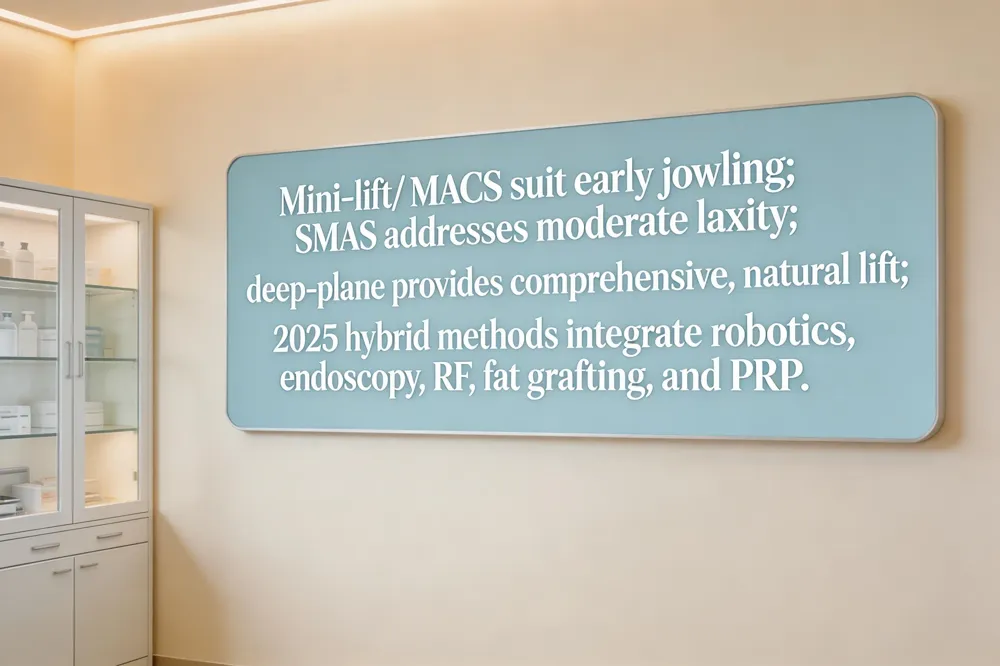 Mini‑lift, SMAS, MACS, and Deep‑Plane comparison – Mini‑lift use short incisions and focus on skin‑tightening for early jowling, offering a quick recovery but limited lift. The SMAS (Superficial Musculoaponeurotic System) facelift re‑positions this fibrous layer, delivering natural, longer‑lasting results for moderate laxity while keeping the skin tension low. MACS (Minimal Access Cranial Suspension) is a short‑scar, minimally invasive technique that lifts the SMAS with limited incisions, ideal for subtle rejuvenation and reduced downtime. The deep‑plane facelift goes beneath the SMAS, releasing retaining ligaments and moving fat, muscle, and skin as a single unit; it provides the most comprehensive mid‑face, jawline, and neck improvement and durability.
Best suitable for each approach – Younger patients in their 40s with mild sagging often benefit from mini‑lift or MACS. Those in their 50s‑60s with moderate to severe laxity are excellent candidates for SMAS lifts. Individuals seeking the most natural, long‑lasting transformation—especially with deep nasolabial folds and jowls—are best served by a deep‑plane or extended deep‑plane procedure.
Emerging 2025 hybrid methods – Surgeons now blend deep‑plane and SMAS concepts with endoscopic assistance, robotic precision, and adjunctive technologies such as radio‑frequency skin tightening, autologous fat grafting, and PRP. These hybrid techniques preserve critical vasculature, minimize swelling, and shorten recovery while delivering durable, age‑appropriate results.
Answers to key questions
- What is the best facelift technique? The optimal technique is patient‑specific; an extended deep‑plane lift is often considered the gold standard for comprehensive, natural rejuvenation, while SMAS and MACS remain reliable for moderate cases.
- [SMAS facelift] – Targets the SMAS layer to lift cheeks, jawline, and neck, offering natural results with moderate downtime.
- [MACS facelift] – Utilizes a short, hidden incision and purse‑string sutures for a subtle, low‑downtime lift.
- Latest facelift techniques 2025 – Combine deep‑plane/SMAS lifts with imaging, robotics, endoscopy, RF tightening, fat grafting, and PRP for personalized, minimally invasive outcomes.
Age and Suitability: Facelifts for Patients in Their 70s and Beyond
 Older adults can safely undergo facial rejuvenation when their overall health supports anesthesia and healing. A thorough pre‑operative assessment—cardiovascular fitness, blood‑pressure control, smoking cessation, and management of chronic diseases such as diabetes—minimizes the risk of hematoma, nerve injury or delayed wound closure. In San Francisco, board‑certified surgeons (e.g., Dr. Corey Maas, Dr. Ginger Xu, Dr. Amit Arunkumar) tailor the plane of dissection to each patient’s tissue quality, often favoring a SMAS‑plication or a limited deep‑plane lift that reduces operative time while still providing durable lift.
Male facial anatomy typically features a broader jawline, denser soft tissue, and more prominent facial hair patterns. Surgeons therefore preserve the natural masculine contour by avoiding over‑tightening of the SMAS, selecting vector‑oriented lifts that enhance jawline definition without erasing masculine angles, and sometimes pairing the facelift with chin or neck augmentation for balanced projection.
When health concerns or extensive skin laxity make a full deep‑plane procedure less advisable, minimally invasive options become attractive. Mini‑facelifts, MACS lifts, thread lifts, and injectable volumizers (fat grafting, dermal fillers) can refresh the lower face and neck with shorter downtime and lower nerve‑injury risk. Combining these adjuncts with a conservative surgical approach often yields natural, long‑lasting results for patients in their 70s and beyond.
Cost Considerations in San Francisco
 Facelift pricing in San Francisco varies widely by technique and scope of care. A full traditional facelift usually falls between $10,000 and $50,000, with higher‑end surgeons and advanced technology pushing the price upward. Mini‑facelifts or less invasive options start around $5,000 to $10,000, while premium deep‑plane lifts can exceed $40,000. A mini deep‑plane facelift which combines a smaller incision with deep‑tissue repositioning, typically costs $8,000 to $15,000 compared with a full deep‑plane lift that may reach $25,000‑$45,000.
Factors that shape the final bill include the surgeon’s fee (the largest component), anesthesia type (general versus local with sedation), facility fees for the operating suite, and any adjunct procedures such as fat grafting, neck lift, or brow lift. Board‑certified surgeons with extensive facial‑plastic training often command higher fees, reflecting their expertise and safety record.
Financing and payment options are widely offered in the Bay Area. Many practices provide flexible payment plans, medical‑credit cards, and third‑party financing to spread the cost over months or years. Patients are encouraged to discuss all fees during the consultation and explore financing options before committing to surgery.
Deep Plane Facelift in San Francisco: What to Expect
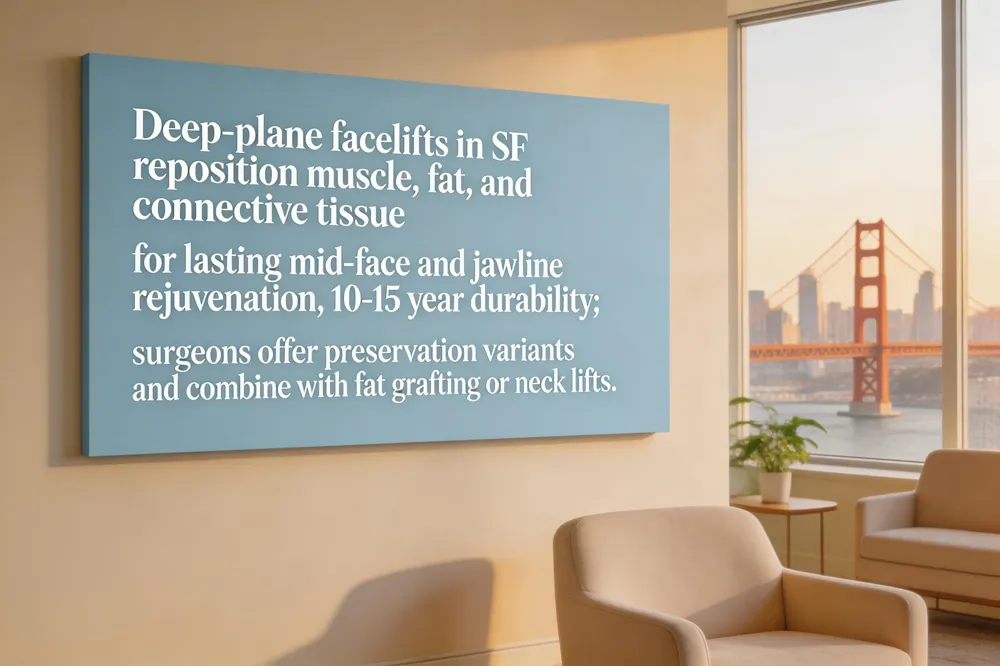 A deep‑plane facelift in San Francisco re‑positions the deeper facial layers—including muscle, fat, and connective tissue—to restore mid‑face volume, lift sagging cheeks and jowls, and smooth deep nasolabial folds for a natural, long‑lasting result. The surgical steps begin with discreet pre‑auricular and post‑auricular incisions, followed by release of the zygomatic and upper masseteric retaining ligaments. The surgeon then lifts the composite flap that includes the SMAS, malar fat pads, and underlying musculature, anchoring it to a higher, tension‑free position. Optional fat grafting restores lost volume, while a neck lift can be added for harmonious rejuvenation.
Ideal candidates are typically in their 40s‑50s, non‑smokers, with moderate skin laxity, loss of mid‑face volume, and prominent jowls or nasolabial folds. Results usually endure 10‑15 years because the deep structural layers are repositioned rather than merely tightened.
Leading Bay‑Area surgeons—Dr. Amit Arunkumar, Dr. Miguel Delgado, and the team at L&P Aesthetics (Drs. Lieberman, Parikh, Curti)—combine the advanced deep‑plane technique with individualized skin‑care protocols and, when needed, complementary procedures such as brow lifts or laser resurfacing. Their personalized approach includes a thorough facial anatomy assessment, discussion of aesthetic goals, and a customized plan that balances safety, minimally invasive recovery, and optimal natural‑looking outcomes.
Deep plane facelift in San Francisco: The procedure restores mid‑face volume, lifts sagging cheeks, and smooths nasolabial folds, delivering a natural result that can last 10‑15 years. Surgeons such as Dr. Arunkumar, Dr. Delgado, and L&P Aesthetics tailor the surgery to each patient’s anatomy and may combine it with neck lifts or facial contouring.
Preservation deep plane facelift: This modern variation keeps skin‑subcutaneous layers largely intact while releasing and repositioning deeper muscles and ligaments as a composite flap. By sparing extensive skin undermining, it reduces tension, scarring, and postoperative swelling, often allowing twilight sedation and a faster recovery while still achieving long‑lasting, natural rejuvenation.
Deep plane facelift results: Patients typically enjoy a refreshed appearance that can last 7‑10 years, with a more defined jawline, lifted cheeks, and reduced neck laxity. Before‑and‑after photos show individuals looking 15‑20 years younger while still appearing like themselves, thanks to the durable repositioning of deep structural layers.
Non‑Surgical and Hybrid Approaches to Facial Rejuvenation
 Modern facial rejuvenation blends surgical expertise with minimally invasive tools to address early‑stage aging and extend the life of a facelift. Ultrasound‑based Ultherapy and radio‑frequency devices (e.g., Thermage, FaceTite) heat deep dermal layers, stimulating collagen production that gradually lifts the jawline, neck, and jowls with virtually no downtime. Thread lifts use dissolvable sutures to reposition sagging tissue, delivering an immediate lift that improves as the threads dissolve over six‑to‑twelve months. Injectable dermal fillers such as Juvederm, Restylane, and Voluma restore lost volume in the cheeks, nasolabial folds, and chin, while neuromodulators like Botox relax dynamic wrinkles for a smoother appearance. These treatments can be combined with a surgical facelift—fat grafting, laser resurfacing, or a neck lift—to fine‑tune contour, enhance volume, and reduce the need for future revisions.
Face lift procedures without surgery: Non‑surgical facelift options focus on tightening skin, restoring volume, and smoothing lines without incisions. Ultherapy, Thermage, thread lifts, and injectables provide modest, natural‑looking lift for early‑stage aging and can be customized to each patient’s aesthetic goals.
Best plastic surgeon in San Francisco: Top‑rated surgeons include Dr. James Anthony (board‑certified plastic surgeon), Dr. Lynn Chiu‑Collins (double‑board‑certified facial plastic surgeon), Dr. Shahin Javaheri (minimally invasive facial specialist), Dr. Robert L. Smith, and Dr. Nicole R. Lee. All are known for artistic, natural results and extensive experience with both surgical and hybrid rejuvenation techniques.
Putting It All Together for a Personalized Rejuvenation Plan
Choosing the right facelift technique in San Francisco hinges on age, skin laxity and budget, and surgeon skill. Deep‑plane and High‑SMAS lifts offer the most durable, natural results for patients in their 50s‑70s, while a mini‑lift or MACS suspension suits younger adults with mild jowling. Costs range from $12,000 to $30,000 depending on the procedure and adjunctive services such as fat grafting, brow lift, or neck lift. Opt for a board‑certified facial plastic surgeon with fellowship training—many Bay‑Area specialists meet ASPS and ABC standards. A thorough consultation should include a detailed facial analysis, realistic before/after expectations, and discussion of risks, financing, and post‑op care. Ready to begin? Schedule a personalized evaluation at a reputable San Francisco practice, ask for a second opinion if needed, and start pre‑operative preparations to ensure a safe, satisfying rejuvenation journey.