What Is a Liquid Facelift?
A liquid facelift is a non‑surgical facial rejuvenation that uses injectable dermal fillers and neuromodulators to restore volume, smooth lines, and subtly lift sagging tissue. Key components include hyaluronic‑acid fillers (e.g., Juvederm, Restylane), collagen‑stimulating agents such as poly‑L‑lactic acid (Sculptra) or calcium hydroxylapatite (Radiesse), and neurotoxins like Botox to relax dynamic wrinkles. The office‑based procedure typically lasts 15‑45 minutes, beginning with a topical anesthetic followed by precise injections; most patients resume normal activities immediately. Ideal candidates are individuals with mild‑to‑moderate skin laxity, fine lines, and modest volume loss who seek quick, reversible results without incisions.
Procedure Details, Candidates, and Expected Outcomes
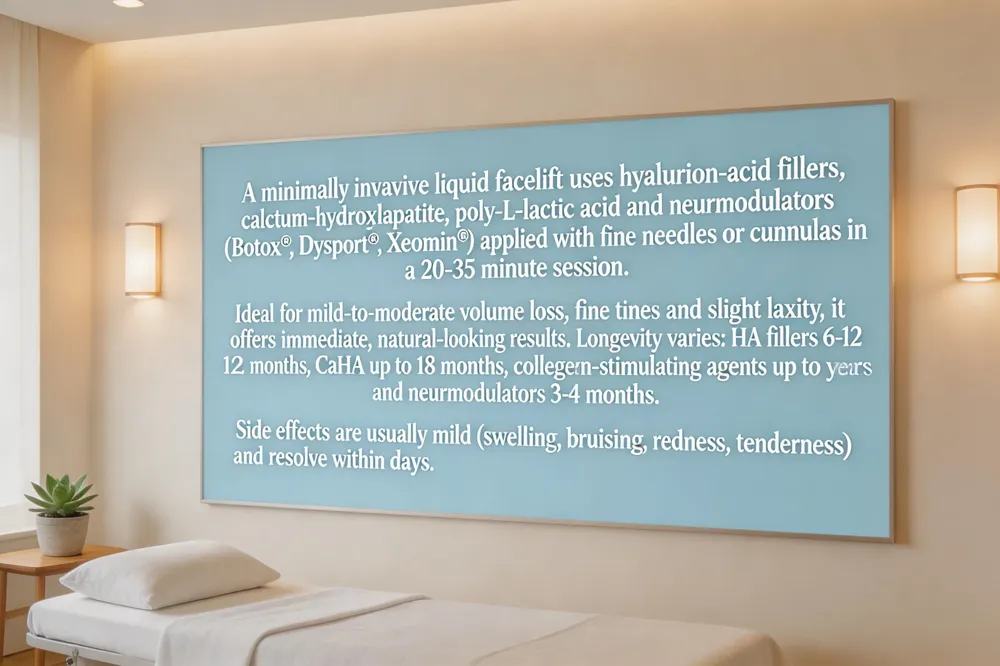 A liquid facelift is a minimally invasive, non‑surgical facial rejuvenation performed by a board‑certified dermatologist or plastic surgeon. The injector applies a topical anesthetic before using fine needles or blunt‑tip cannulas to place multiple small injections in targeted zones; the entire session typically lasts 20–35 minutes. Common fillers include hyaluronic‑acid gels (Juvederm®, Restylane®, Belotero®), calcium‑hydroxylapatite (Radiesse®), poly‑L‑lactic acid (Sculptra®), and non‑absorbable PMMA beads, while neuromodulators such as Botox®, Dysport® or Xeomin® relax dynamic muscles. Ideal candidates are individuals with mild‑to‑moderate volume loss, fine lines, and mild skin laxity—those who want immediate, natural results without the downtime of surgery. In the San Francisco area, a comprehensive liquid facelift generally ranges from $1,500 to $5,000, depending on product type, treatment zones, and injector expertise. Side effects are usually mild and short‑lived: temporary swelling, bruising, redness, and tenderness that resolve within a few days; rare complications include allergic reaction, infection, or vascular occlusion. Longevity varies by product—hyaluronic fillers last 6‑12 months, calcium‑hydroxylapatite up to 18 months, and collagen‑stimulating agents up to two years; neuromodulators typically last 3‑4 months.
Visual Results, Alternatives, and Age‑Specific Options
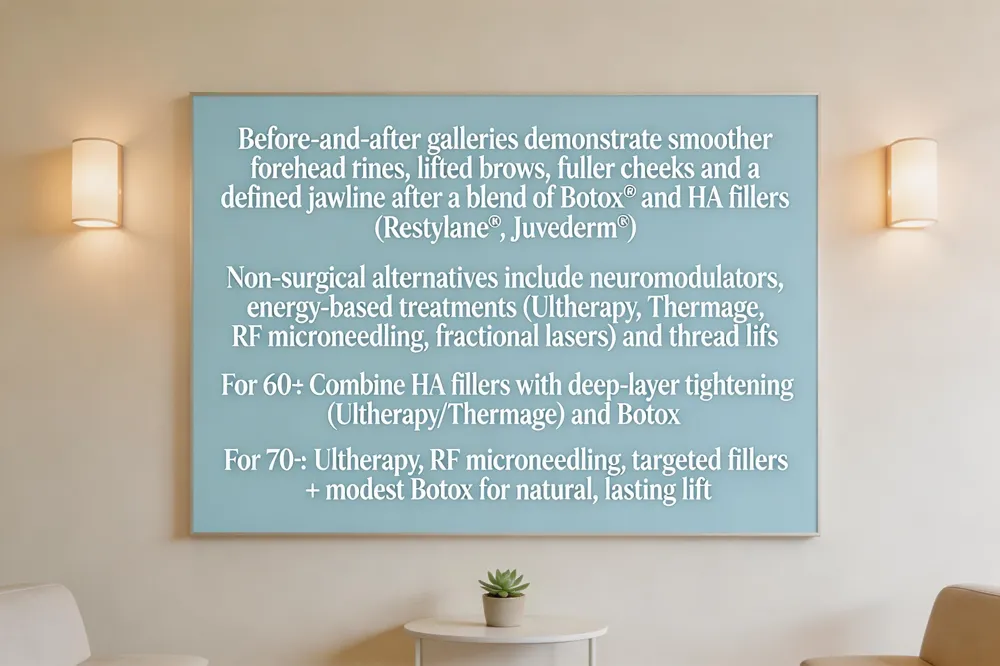 Before‑and‑after galleries are a powerful way to see the impact of a liquid facelift. Side‑by‑side photos typically show smoother forehead lines, lifted brows, fuller cheeks and a more defined jawline after a blend of Botox® and hyaluronic‑acid fillers such as Restylane® or Juvederm®. These images help set realistic expectations and demonstrate the natural, incision‑free rejuvenation that many clinics, including our San Francisco Aesthetic Surgery Center, showcase online.
If you prefer to avoid surgery altogether, a range of non‑invasive alternatives exists. Injectable neuromodulators (Botox, Dysport) combined with volumizing fillers restore lost volume and relax dynamic wrinkles. Energy‑based treatments—Ultherapy, Thermage, radiofrequency microneedling, and fractional lasers—stimulate deep collagen for skin tightening and subtle lifting. Thread lifts or plasma fibroblast procedures add a modest lift with minimal downtime.
For patients over 60, the best approach pairs hyaluronic‑acid fillers with deep‑layer tightening technologies such as Ultherapy or Thermage, plus Botox for fine lines. At age 70, a customized protocol of Ultherapy, RF microneedling, targeted fillers and a small amount of Botox offers the most natural, lasting lift.
Addressing jowls specifically, clinicians often combine focused ultrasound (Ultherapy/HIFU) or RF microneedling (Morpheus8) with strategic “JOLT” fillers or PDO thread lifts to achieve both immediate contour and gradual collagen‑driven lift. All treatments should be performed by a board‑certified, experienced injector to ensure safety and optimal results.
Cost, Availability, and Local Expertise
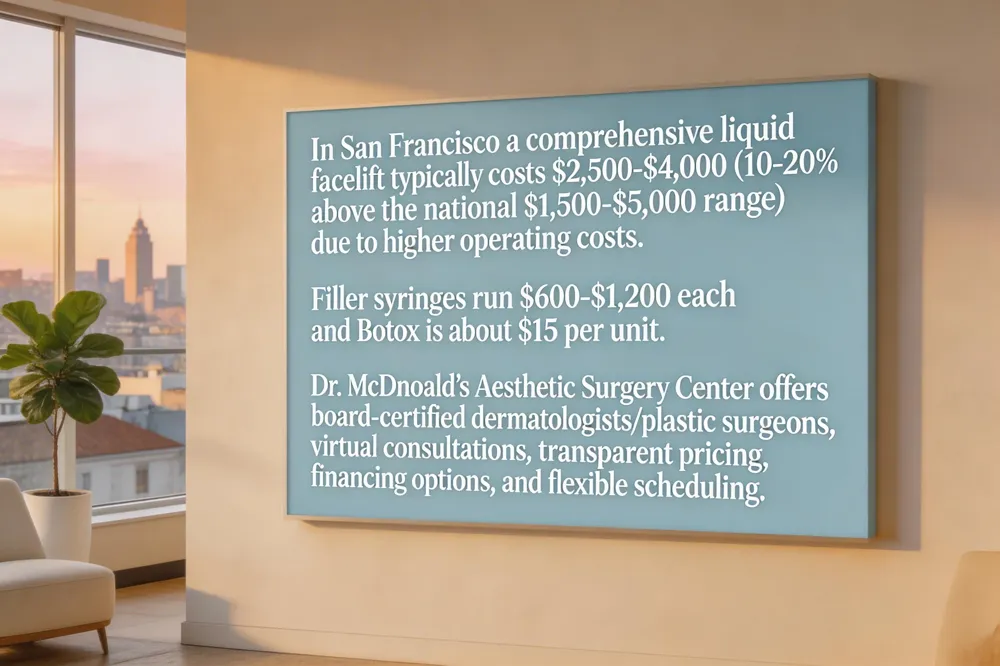 Non‑surgical facelift costs vary widely. A single liquid‑facelift session in the United States typically ranges from $1,500 – $5,000, with filler syringes costing $600‑$1,200 each and neuromodulators such as Botox priced around $15 per unit. In San Francisco prices are 10‑20 % higher due to local operating costs, so most patients spend $2,500 – $4,000 for a comprehensive treatment.
To find a liquid facelift near you, look for board‑certified dermatologists or plastic surgeons who specialize in injectable rejuvenation. In San Francisco, Dr. McDonald’s Aesthetic Surgery Center offers personalized liquid‑facelift plans using FDA‑approved hyaluronic‑acid fillers, calcium‑hydroxylapatite, poly‑L‑lactic acid, and neuromodulators. The clinic provides virtual consultations, flexible scheduling, and transparent pricing after a detailed facial assessment.
Financing options and payment plans are commonly available, allowing patients to spread the out‑of‑pocket expense. Compared with a surgical facelift, which can exceed $10,000 and require weeks of recovery, a liquid facelift is less invasive, has minimal downtime, and offers a lower upfront cost—making it an attractive alternative for those with mild‑to‑moderate facial aging who desire natural‑looking results without surgery.
All procedures are performed in an office setting, typically completed in 30‑60 minutes, and patients can resume normal activities the same day.
Safety, After‑Care, and Additional FAQs
 A liquid facelift is a minimally invasive, non‑surgical facial rejuvenation that combines dermal fillers and neuromodulators.
What are the side effects of a liquid facelift?
Common, temporary effects include bruising, swelling, redness, tenderness, itching, or a feeling of tightness at the injection sites, typically resolving within a few days. Less frequent issues are lumpiness, small nodules, allergic reactions, infection, or rare vascular occlusion. Management involves applying ice, using over‑the‑counter analgesics, following hydration and sun‑avoidance guidelines, and adhering to the provider’s after‑care instructions. Serious complications are uncommon when performed by an experienced, board‑certified injector.
What is a liquid facelift vs fillers?
A liquid facelift strategically layers fillers and neurotoxins across multiple facial zones to restore volume, smooth lines, and create a subtle lift, yielding a more comprehensive rejuvenation. Stand‑alone fillers mainly add volume to specific spots and do not provide the same lifting effect. Both are personalized, but a liquid facelift offers a broader, more contoured result that typically lasts 6‑12 months before touch‑ups are needed.
Non‑surgical facelift before and after
Before treatment, patients often show loss of cheek fullness, deep nasolabial folds, and mild sagging. After a customized regimen of Botox®, hyaluronic‑acid fillers, and optional energy‑based tightening (e.g., Ultherapy), the face appears smoother, more defined, and three‑dimensional, with results visible within days to weeks and lasting 12‑18 months.
Should a 70‑year‑old get a facelift?
Chronological age alone is not a contraindication. Healthy seniors with good skin quality and realistic expectations can be excellent candidates for surgical or nonsurgical lifts, provided a thorough medical evaluation and personalized plan are completed.
Liquid facelift procedure near me
For patients in the Bay Area, the Aesthetic Surgery Center in San Francisco offers board‑certified facial plastic surgeons who perform liquid facelifts using Botox®, Juvederm®, Radiesse®, and Sculptra®. The office is completed in under an hour with minimal downtime. To schedule a confidential consultation, call (415) 555‑1234 or book online.
Choosing the Right Path for Facial Rejuvenation
A liquid facelift offers immediate volume restoration, wrinkle smoothing, and subtle lifting without incisions, anesthesia, or downtime, making it an attractive option for mild‑to‑moderate aging concerns. Success hinges on treatment by a board‑certified dermatologist, plastic surgeon, or trained injector who understands facial anatomy and can manage rare complications. Each patient receives a personalized plan that blends hyaluronic‑acid fillers, neuromodulators, and, when appropriate, collagen‑stimulating agents to address specific areas such as cheeks, under‑eye hollows, or jawline. For those interested, the next step is a thorough consultation to discuss goals, review medical history, and schedule a tailored treatment session.