Introduction: Navigating Laser Options for Anti‑Aging
Laser resurfacing has become a cornerstone of modern anti‑aging medicine, offering both ablative and non‑ablative pathways to smoother, firmer skin. At our San Francisco aesthetic center we employ fractional CO₂ and Er:YAG systems—each leveraging water‑absorbing wavelengths (10,600 nm for CO₂, 2,940 nm for Er:YAG) to create micro‑thermal zones that stimulate collagen remodeling while preserving surrounding tissue. Selecting the right device depends on several factors: depth of wrinkles, skin texture, Fitzpatrick skin type, and the patient’s tolerance for downtime. Deep rhytides and severe sun‑damage often benefit from fractional CO₂’s greater thermal effect, whereas patients with darker tones or a need for a quicker recovery gravitate toward fractional Er:YAG, which offers precise ablation with minimal heat diffusion and a lower risk of post‑inflammatory hyperpigmentation. Our personalized protocol begins with a thorough skin analysis, followed by a customized treatment plan that balances efficacy, safety, and the individual’s lifestyle—ensuring optimal results and a comfortable experience.
Understanding Fractional CO₂ Laser Technology
| Feature | Fractional CO₂ Laser | Non‑ablative Fractional (e.g., Fraxel) |
|---|---|---|
| Mechanism | Micro‑thermal zones (MTZs) that vaporize epidermis and heat dermis | Micro‑thermal zones that heat dermis without vaporizing epidermis |
| Depth of injury | Deeper (ablative) – up to 1–2 mm depending on settings | Shallower (non‑ablative) – typically <0.5 mm |
| Downtime | 5‑7 days (redness, swelling, crusting) | 1‑2 days (mild erythema) |
| Ideal concerns | Deep wrinkles, pronounced scarring, photo‑damage | Fine lines, mild texture irregularities, early‑stage pigment issues |
| Risk of hyperpigmentation | Higher, especially in Fitzpatrick III‑VI | Lower, safer for darker skin tones |
| Pain/comfort | Moderate – topical anesthesia used | Minimal – often no anesthesia needed |
| Cost per session (San Francisco) | $2,000‑$3,500 | $1,200‑$1,800 |
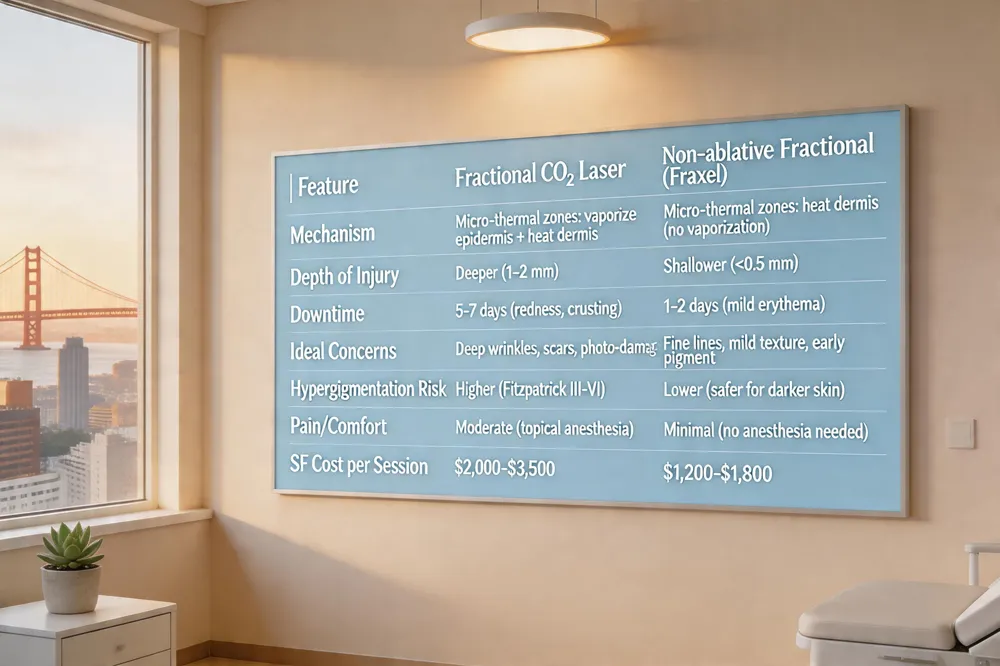 Fractional CO2 laser resurfacing delivers micro‑thermal zones (MTZs) – tiny columns of controlled ablation surrounded by untouched skin – that trigger a wound‑healing cascade and new collagen formation. This precise pattern allows rapid re‑epithelialization, making the treatment especially effective for smoothing skin texture, reducing fine lines, and lightly improving mild scarring. Compared with full‑field ablative CO2, which removes entire surface layers and demands longer downtime, fractional CO2 offers a balanced approach: deeper thermal injury than non‑ablative lasers for noticeable remodeling, yet a shorter recovery period (typically 5‑7 days) and lower risk of complications.
Fractional CO2 laser – At our San Francisco Aesthetic Surgery Center we customize MTZ depth and density to each patient’s skin type, achieving smoother texture and finer lines with minimal downtime.
Fractional laser vs CO2 for face – Non‑ablative fractional lasers (e.g., Fraxel) provide gentle resurfacing and 1‑2 days of redness, while ablative CO2 delivers more pronounced collagen tightening for deep wrinkles. Our specialists assess goals and Fitzpatrick skin type to recommend the optimal option.
Fractional laser vs CO2 side effects – Non‑ablative fractional treatments usually cause mild erythema lasting 1‑2 days; ablative CO2 may cause swelling, crusting, and erythema for up to a week. We provide detailed after‑care instructions, including sun protection and moisturization, to minimize side effects and support optimal healing.
CO₂ vs Fraxel for Targeted Concerns
| Concern | CO₂ Laser (Ablative) | Fraxel (Non‑ablative) | Typical Sessions | Approx. Cost per Session |
|---|---|---|---|---|
| Stretch marks (older, established) | Deep ablation → rapid collagen remodeling, dramatic improvement | Gentler MTZs → smoother recovery, good for newer marks | 1‑3 | $2,000‑$3,500 |
| Stretch marks (newer, finer) | Effective but higher downtime | Preferred for minimal downtime | 2‑4 | $1,200‑$1,800 |
| Acne scarring (deep, atrophic) | Penetrates dermis, reduces deep pits | Targets superficial texture | 1‑2 | $2,000‑$3,500 |
| Acne scarring (superficial) | May be overtreatment | Ideal for fine texture | 2‑4 | $1,200‑$1,800 |
| Overall anti‑aging | Strong wrinkle tightening | Moderate, maintenance‑oriented | 3‑4 (combined) | $2,000‑$3,500 (CO₂) + $1,200‑$1,800 (Fraxel) |
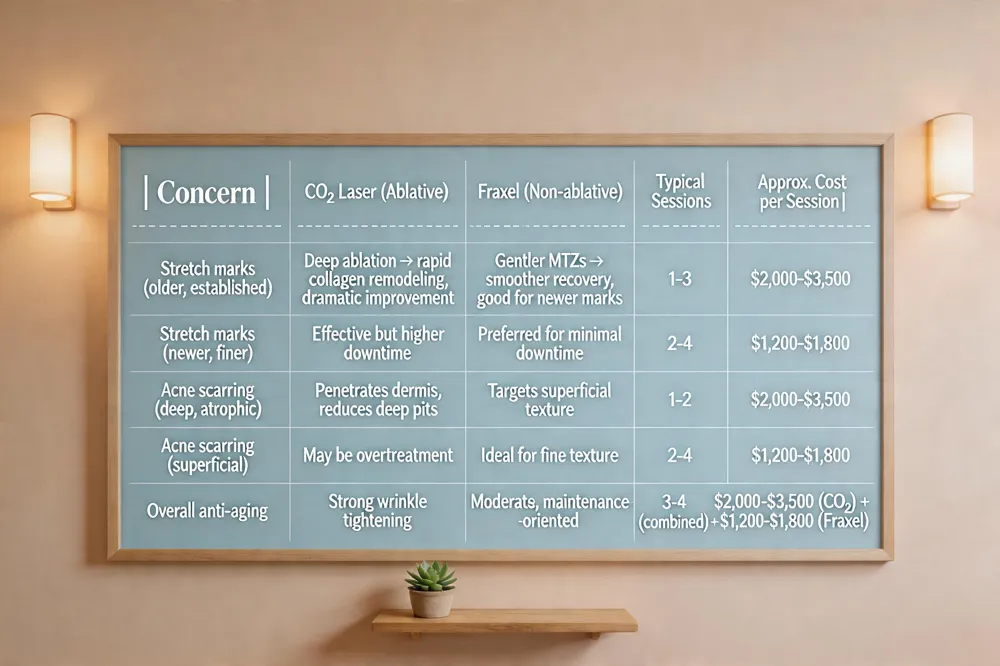 When treating stretch marks, both Fraxel (non‑ablative) and CO₂ (ablative) lasers can be effective, but they work differently. CO₂ delivers deeper tissue ablation, promoting rapid collagen remodeling and often yielding faster, more dramatic improvement, especially for older, established marks. Fraxel creates micro‑thermal zones that are gentler on the skin, resulting in a smoother recovery and is ideal for newer, finer stretch marks.
For acne scarring, CO₂ laser resurfacing penetrates the dermis and can markedly reduce deep, atrophic scars, while Fraxel focuses on superficial texture irregularities with minimal downtime. Many San Francisco specialists combine the two modalities to address both deep and superficial scar components in a single treatment plan.
Pricing reflects the depth and recovery time of each technology. CO₂ resurfacing generally commands a higher fee—starting at $2,000 per session—due to its ablative nature and longer post‑procedure care. Fraxel treatments are more affordable, beginning at $1,200 per session, with a typical regimen of 3–4 sessions for optimal results.
Er:YAG and Other Fractional Options for Anti‑Aging
| Laser | Wavelength | Ablation Depth (Typical) | Downtime | Ideal Fitzpatrick Types | Key Benefits |
|---|---|---|---|---|---|
| Er:YAG | 2,940 nm | Very shallow (0.1‑0.3 mm) | 1‑3 days (redness) | III‑VI (darker skin) | Minimal thermal spread, low hyperpigmentation risk |
| Fractional CO₂ | 10,600 nm | Deeper (0.5‑2 mm) | 5‑7 days | I‑II (fair skin) | Strong collagen tightening, deep wrinkle reduction |
| Fraxel (Non‑ablative) | 1,550 nm | Superficial (0.05‑0.2 mm) | 1‑2 days | I‑VI (all) | Gentle, good for early signs of aging |
| IPL (Intense Pulsed Light) | Broad spectrum | No ablation (photothermolysis) | <1 day | I‑III (lighter) | Pigment and vascular lesion treatment |
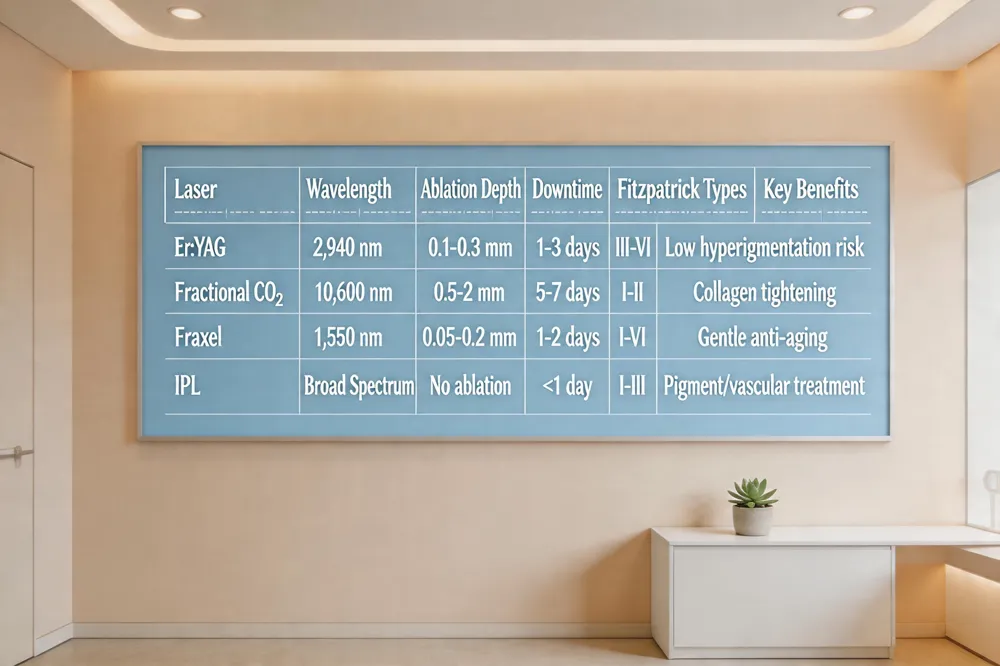 Er:YAG lasers operate at a 2,940 nm wavelength that is almost perfectly absorbed by water, allowing precise epidermal ablation with minimal thermal spread. This high‑absorption profile yields shallow, controlled micro‑thermal zones (MTZs) that stimulate collagen remodeling while preserving surrounding tissue, making the procedure especially comfortable for patients.
For Fitzpatrick skin types III‑VI, the reduced heat diffusion of Er:YAG translates into a lower incidence of post‑inflammatory hyperpigmentation compared with CO₂. Studies consistently show shorter erythema (1‑3 days) and faster re‑epithelialization, which is why many clinicians favor Er:YAG for darker skin tones.
Combination protocols often start with an Er:YAG resurfacing pass to smooth the surface, followed by a deeper fractional CO₂ session for pronounced collagen contraction. This staged approach maximizes anti‑aging benefits while keeping downtime manageable.
Which laser treatment is best for anti‑aging? For most patients, ablative CO₂ delivers the most dramatic wrinkle and texture improvement; Er:YAG offers a gentler alternative with quicker recovery, and non‑ablative options like Fraxel provide minimal‑downtime maintenance.
Best laser for skin tightening and wrinkles – CO₂ laser resurfacing remains the gold‑standard for deep tightening and deep wrinkle reduction, while fractional non‑ablative lasers can be used for milder results.
Best laser for skin tightening on face – CO₂ provides the deepest tightening on facial skin; fractional non‑ablative lasers are available for patients seeking a less aggressive approach.
CO₂ Laser: Efficacy, Cost, and Patient Experience
| Metric | Value / Range |
|---|---|
| Skin elasticity improvement | Up to 30 % after 3‑4 sessions |
| Fine‑line reduction | Up to 70 % (clinical photos) |
| Typical downtime | 5‑10 days (redness, swelling, crusting) |
| Session cost (San Francisco) | $2,000‑$3,500 |
| Full anti‑aging series (3‑4 sessions) | $6,000‑$9,000 |
| Patient satisfaction rating | 4.8 / 5 average |
| Reported “younger look” | 5‑10 years younger appearance |
| Common side‑effects | Temporary redness, swelling, crusting |
| Pain management | Topical anesthesia + post‑procedure moisturization |
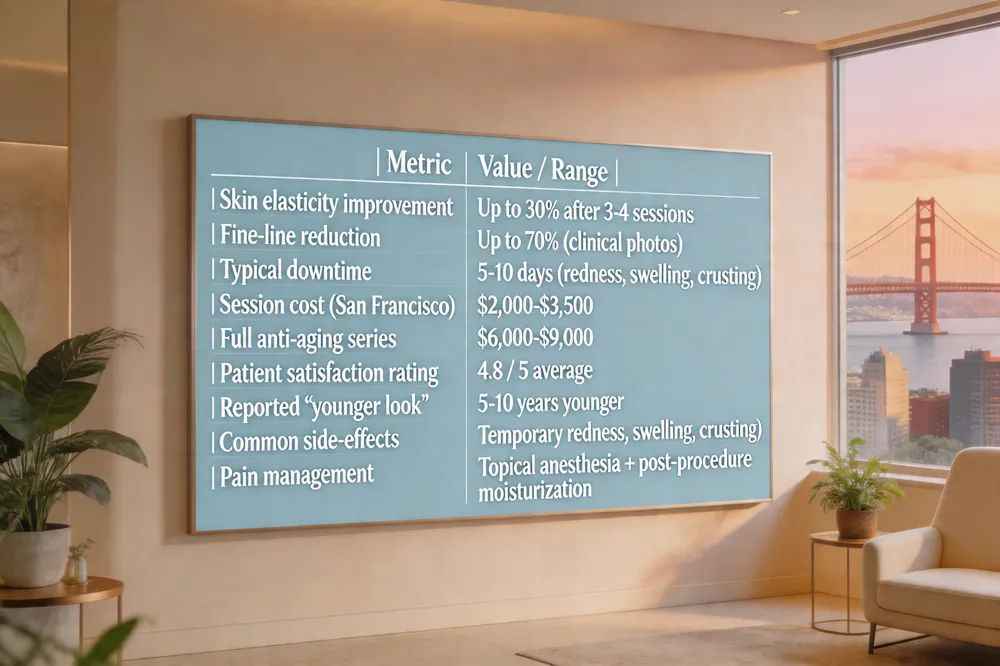 Fractionar CO₂ laser resurfacing delivers micro‑thermal zones that vaporize epidermal tissue and heat the dermis, stimulating deep collagen remodeling and reducing fine lines, deep wrinkles, and photo‑damage. Clinical studies report up to a 30 % increase in skin elasticity after three to four sessions, with lasting results for years when combined with diligent sun protection.
In the Bay Area, a single ablative CO₂ session ranges from $2,000‑$3,500; a full anti‑aging series (3‑4 treatments) typically totals $6,000‑$9,000.
Common side‑effects include temporary redness, swelling, and crusting that resolve within 7‑10 days; topical anesthesia and post‑procedure moisturization keep pain tolerable.
Patient reviews are overwhelmingly positive—our San Francisco clinic averages a 4.8/5 rating, with many reporting a 5‑10‑year younger appearance after treatment.
FAQ
- CO₂ laser anti‑aging Reddit: Users note dramatic line reduction; we follow evidence‑based protocols for safety.
- CO₂ laser anti‑aging reviews: 4.8/5 satisfaction for texture and firmness.
- Before‑and‑after: Photos show up to 70 % fine‑line reduction.
- Side‑effects: Redness, swelling, crusting—managed with after‑care.
- Pain vs. Fraxel: Slightly more discomfort, but anesthesia ensures tolerable levels.
- Disadvantages: Longer downtime, higher cost, pigment risk in darker skins—mitigated by pre‑treatment analysis and care.
- Younger look: Patients feel 5‑10 years younger after a series.
- Fraxel + CO₂: Combination yields marked tone and scar improvement.
Patient Considerations: Age, Skin Type, and Safety
| Factor | Details |
|---|---|
| Age suitability | Safe for mature patients up to 70s+ if skin health is good |
| Fitzpatrick skin type | III‑VI – higher hyperpigmentation risk with CO₂; prefer Er:YAG or non‑ablative options |
| Contraindications | Recent isotretinoin, active infection, uncontrolled diabetes, keloidal scarring, recent sun exposure |
| Pre‑treatment prep | Discontinue photosensitizing meds, SPF 30+ sunscreen, skin‑priming regimen |
| Post‑procedure care | Sun protection, moisturization, possible antiviral prophylaxis |
| Cost vs. downtime trade‑off | CO₂ higher cost & longer downtime; Er:YAG lower cost & quicker recovery |
| Safety protocols | FDA‑cleared devices, board‑certified physicians, individualized settings |
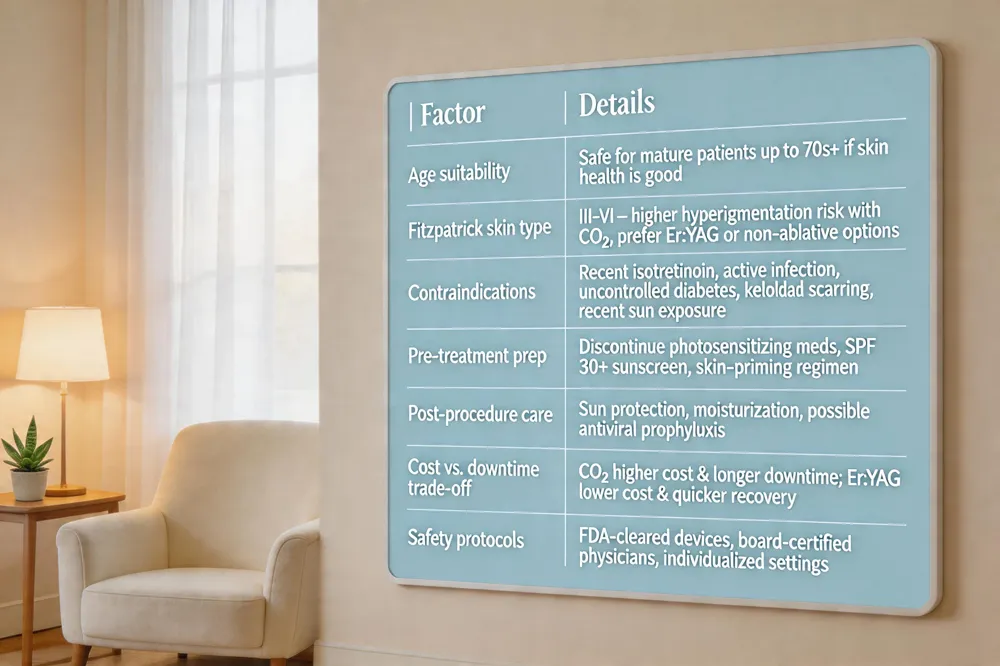 Fractional laser resurfacing is safe for mature patients; even individuals in their 70s can be treated when skin health is good and no contraindications exist, as we confirm during a comprehensive assessment at our San Francisco clinic. Fitzpatrick skin type is a key factor: darker types (III‑VI) have a higher risk of post‑inflammatory hyperpigmentation with ablative CO₂ lasers, so we often favor Er:YAG or non‑ablative fractional options that deliver precise ablation with minimal thermal spread. Contraindications include recent isotretinoin use, active infections, uncontrolled diabetes, keloidal scarring, and recent sun exposure; patients are asked to discontinue photosensitizing medications, use broad‑spectrum SPF 30+ sunscreen, and follow a pre‑treatment skin‑priming regimen. CO₂ laser drawbacks—longer downtime, higher hyperpigmentation risk, and greater cost—are mitigated by personalized settings and diligent post‑care. Reddit users commonly cite fractional CO₂ and Fraxel for rejuvenation, and our practice leverages these technologies with physician‑guided protocols for optimal safety and results. For facial hair removal we employ diode and Alexandrite lasers, tailored to each patient’s skin type for minimal irritation. Our suite of facial laser treatments includes CO₂, Fraxel, Er:YAG, and IPL, each selected to address texture, tone, pigmentation, or scarring based on individual needs.
Choosing the Right Laser at Our San Francisco Center
| Laser Type | Primary Indication | Customization Parameters | Downtime | Approx. Cost per Session |
|---|---|---|---|---|
| Ablative CO₂ | Deep wrinkles, severe scarring, photo‑damage | MTZ depth, density, pulse energy | 5‑7 days | $2,000‑$3,500 |
| Fractional Er:YAG | Fine lines, moderate texture, darker skin types | MTZ depth (shallower), pulse duration | 1‑3 days | $1,800‑$2,500 |
| Non‑ablative Fraxel | Early‑stage aging, mild texture, pigment issues | Density, coverage area | 1‑2 days | $1,200‑$1,800 |
| IPL | Pigment, vascular lesions, mild texture | Fluence, pulse width | <1 day | $150‑$300 |
| Combination (CO₂ + Fraxel) | Comprehensive anti‑aging & scar remodeling | Staged protocol: surface Er:YAG → deep CO₂ | 5‑7 days overall | $3,200‑$4,500 per combined visit |
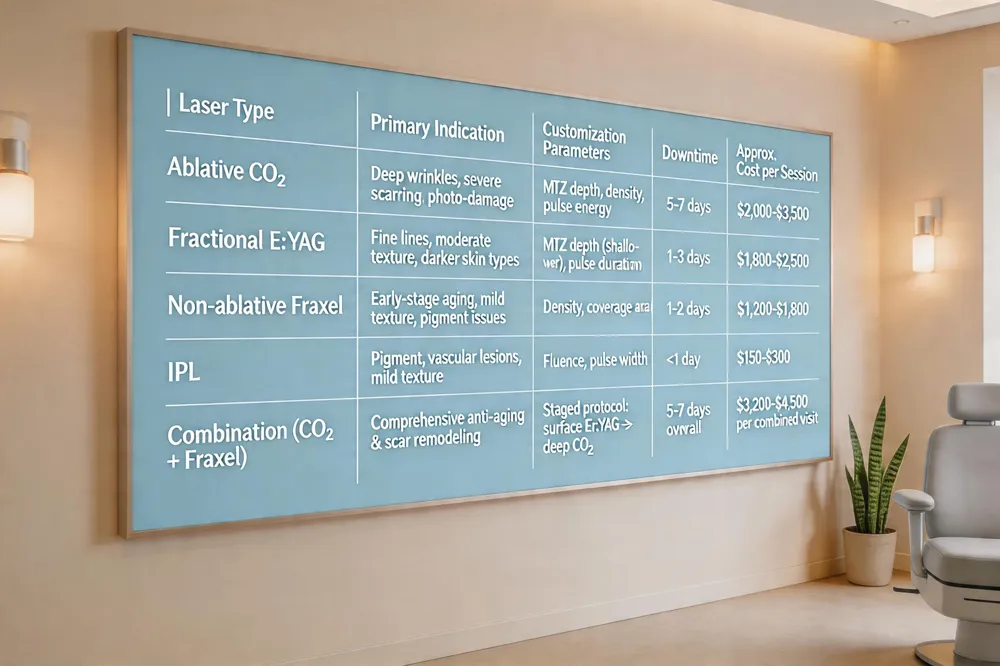 Our San Francisco aesthetic surgery center is led by board‑certified dermatologists and plastic surgeons who specialize in laser resurfacing. With extensive training on FDA‑cleared CO₂, Er:YAG, and fractional systems such as Fraxel, they tailor each protocol to your Fitzpatrick skin type, wrinkle depth, and downtime tolerance.
Custom treatment planning – We begin with a detailed skin analysis, then select the optimal laser modality: deep ablative CO₂ for marked wrinkling and scar remodeling, or gentler fractional Er:YAG for fine lines and moderate texture improvement with less erythema. Combination protocols (e.g., CO₂ laser resurfacing followed by non‑ablative maintenance) extend durability while minimizing repeat procedures.
Home vs. in‑office options – At‑home LED or micro‑needling devices can provide modest maintenance, but they lack the tissue‑level ablation and collagen induction achieved in our clinic. For significant rejuvenation, the professional CO₂ or Fraxel treatments we offer deliver superior results.
FAQ
- Best laser for skin rejuvenation at home: Light‑emitting devices help preserve results, yet they cannot replace the depth of in‑office CO₂ or Fraxel resurfacing.
- Best laser for face at‑home: At‑home LED or microneedling tools are adjuncts only; schedule a consultation for personalized facial laser work.
- Best laser treatment for face near me: Our San Francisco center provides CO₂, Er:YAG, and Fraxel treatments performed by board‑certified surgeons.
- Fraxel CO₂ laser before and after: Before‑and‑after images on our website illustrate marked improvements in tone and scar reduction after combined Fraxel‑CO₂ protocols.
- Best laser for skin tightening on face: CO₂ laser resurfacing offers the most dramatic tightening; fractional non‑ablative lasers give a gentler, incremental effect. Both are available here.
Safety protocols—including pre‑treatment photoprotection, antiviral prophylaxis when needed, and meticulous post‑care—ensure optimal outcomes and minimal complications.
Conclusion: Tailoring Laser Technology to Your Anti‑Aging Goals
CO₂ and Er:YAG lasers are both ablative but differ in wavelength, depth and thermal injury. CO₂ (10,600 nm) creates deeper columns and strong collagen remodeling, ideal for severe wrinkles, deep acne scars and pronounced photo‑damage; it typically requires 5‑10 days of downtime and carries a higher risk of post‑inflammatory hyperpigmentation in Fitzpatrick III‑VI skin. Er:YAG (2,940 nm) vaporizes tissue with minimal heat diffusion, offering precise resurfacing, quicker healing (1‑3 days) and a lower pigment‑change profile, making it suitable for moderate wrinkles, fine lines and darker skin tones. Fractional delivery of either laser—micro‑thermal zones surrounded by untreated skin—balances efficacy and safety, reducing recovery to 3‑7 days while still stimulating neocollagenesis. Because skin type, aging depth, lifestyle and downtime tolerance vary, a personalized assessment is essential to choose the right wavelength, fractional density and treatment plan. Ready for smoother, tighter skin? Schedule a private, board‑certified consultation with our San Francisco aesthetic team today and let us design a laser protocol tailored to your anti‑aging goals and lasting confidence.