Introduction
Board certification is the gold‑standard credential that confirms a facial plastic surgeon has completed rigorous education, accredited residency training (in otolaryngology‑head and neck surgery or plastic surgery), and a dedicated facial‑plastic fellowship. In the United States the American Board of Facial Plastic and Reconstructive Surgery (ABFPRS) grants this certification only after a surgeon first earns primary board status from the American Board of Otolaryngology‑Head and Neck Surgery (ABOTO) or the American Board of Plastic Surgery (ABPS) and successfully passes a comprehensive written and oral examination. This layered validation ensures the surgeon possesses deep knowledge of facial anatomy, advanced aesthetic and reconstructive techniques, and strict ethical standards. For patients, board certification directly translates into higher safety: certified surgeons operate in accredited facilities, adhere to evidence‑based protocols, and engage in ongoing continuing‑medical‑education programs that keep them current with emerging technologies and complication‑management strategies. Selecting a board‑certified facial plastic surgeon therefore minimizes risk and maximizes the likelihood of optimal, natural‑looking results.
Understanding the Certification Landscape
 The pathway to board certification in facial plastic surgery begins with one of two primary specialty boards recognized by the American Board of Medical Specialties (ABMS): the American Board of Otolaryngology‑Head and Neck Surgery (ABOTO) and the American Board of Plastic Surgery (ABPS. Surgeons who complete an ACGME‑accredited residency in otolaryngology or plastic surgery are eligible for primary board certification by these bodies.
To demonstrate expertise that is narrowly focused on the face, many surgeons pursue additional certification from the American Board of Facial Plastic and Reconstructive Surgery (ABFPRS). Established in 1986, ABFPRS is the only board devoted exclusively to facial aesthetics and reconstruction. Certification requires prior primary board certification (ABOTO or ABPS), successful completion of a ‑‑2‑year facial plastic surgery fellowship, and passing a rigorous two‑day written and oral examination.
Surgeons who hold both primary board certification and ABFPRS status are considered double‑board certified, a distinction that signals comprehensive training in both general plastic or otolaryngology principles and subspecialty facial techniques.
Is there a board certification for facial plastic surgery? Yes. The ABFPRS is recognized as equivalent to ABMS member boards in California and other states, and its diplomates have completed dedicated fellowship training in facial plastic surgery.
What is the difference between the American Board of Facial Plastic Surgery and the American Board of Plastic Surgery? ABPS certifies surgeons with full‑spectrum plastic‑surgery training, qualified to operate on any body region. ABFPRS focuses solely on the head and neck, requiring additional fellowship training after a primary residency, and thus signals deeper expertise in procedures such as rhinoplasty, facelifts, and facial nerve reconstruction.
What are the requirements for American Board of Plastic Surgery certification? Candidates must complete a five‑year general surgery foundation (or equivalent), followed by three years of an independent plastic‑surgery residency (or six years in an integrated program) at an ACGME‑accredited institution, pass the ABPS written and oral exams, and maintain certification through continuous medical education and periodic re‑assessment.
Training Pathways to Becoming a Board‑Certified Surgeon
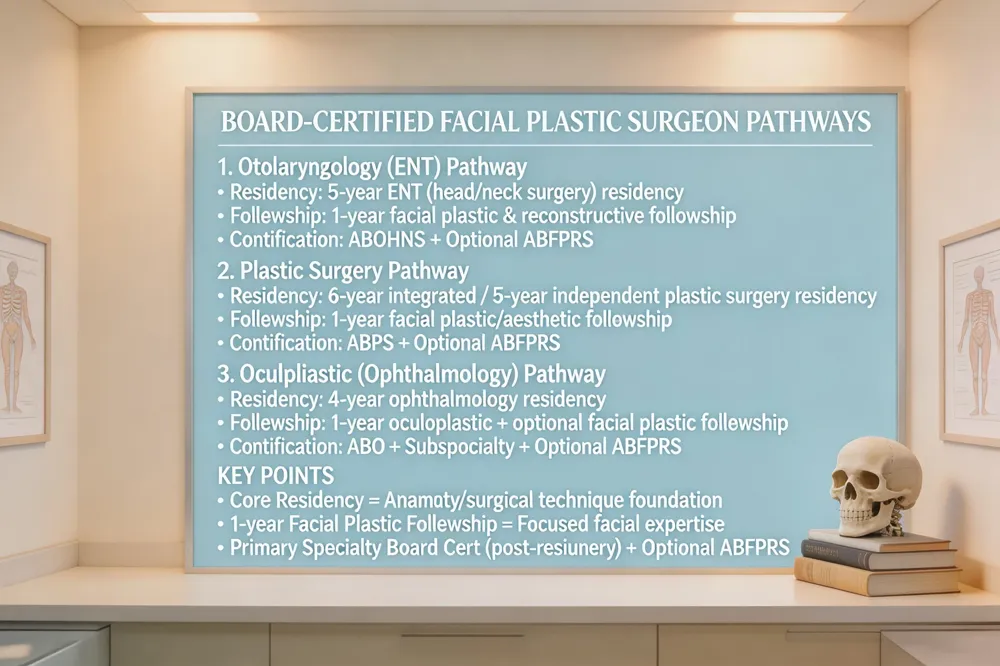 Choosing a board‑certified facial plastic surgeon begins with understanding the rigorous training pathways that lead to certification.
Residency options
The primary routes are an otolaryngology‑head and neck surgery residency (5‑6 years) or a plastic surgery residency (5‑6 years). Both residencies are ACGME‑accredited and provide the broad surgical foundation required before subspecialization.
Fellowship training
After residency, surgeons typically complete a 1‑2 year fellowship focused exclusively on facial plastic and reconstructive surgery. This fellowship, often performed at a high‑volume academic center, sharpens skills in rhinoplasty, facelifts, blepharoplasty, and complex facial reconstruction. Completion of the fellowship is a prerequisite for the American Board of Facial Plastic and Reconstructive Surgery (ABFPRS) certification, which involves a two‑day written and oral examination.
Oculplastic route
Ophthalmology graduates can pursue an oculplastic fellowship, qualifying them to perform cosmetic and reconstructive procedures around the eyes and adjacent facial regions. This pathway emphasizes delicate anatomy of the orbital and peri‑ocular structures.
How many years does it take to become a board‑certified plastic surgeon?
Becoming a board‑certified plastic surgeon typically requires at least 10 years of post‑secondary education and training. First, you must complete a four‑year undergraduate degree followed by four years of medical school. After medical school, you enter either an integrated plastic surgery residency that lasts six years or a traditional pathway of a five‑year general surgery residency followed by a three‑year plastics fellowship (also about eight years). The integrated program is the most common route and totals roughly 14 years from the start of college. Finally, you must pass the American Board of Plastic Surgery’s written and oral examinations to earn board certification.
How do I get ABPS certified?
To become ABPS‑certified you must first finish an ACGME‑ or AOA‑approved plastic‑surgery residency (or the equivalent advanced training for your specialty) and hold an unrestricted medical license. You then submit an application before the board’s deadline, attesting that you have completed a non‑remedial medical‑ethics course and meet the required continuing‑medical‑education hours. After your application is accepted you will sit for the computer‑based, multiple‑choice written examination; many specialties also require you to pass an oral exam after the written test. Upon successfully passing the required examinations, you will be granted ABPS board certification and become a Diplomate of the American Board of Physician Specialties. Finally, you must maintain certification by completing the board’s recertification requirements, typically every eight years.
Why Choosing a Board‑Certified Facial Plastic Surgeon Is Crucial
 Board certification is the most reliable indicator that a facial plastic surgeon has completed a rigorous, accredited residency (otolaryngology‑head and neck or plastic surgery), a dedicated 1‑2‑year fellowship in facial aesthetics, and the demanding written and oral exams required by the American Board of Facial Plastic and Reconstructive Surgery (ABFPRS) or the American Board of Plastic Surgery (ABPS). This extensive training translates directly into patient safety: certified surgeons are versed in the intricate facial anatomy, nerve‑vessel pathways, and anesthesia protocols that prevent intra‑operative injuries. Studies consistently show lower complication rates and higher satisfaction scores for patients treated by board‑certified surgeons, reflecting their mastery of technique and ability to manage unexpected events.
Ethical standards are built into the certification process. Diplomates must adhere to a strict code of conduct, disclose accurate information in advertising, and participate in ongoing continuing‑medical‑education and maintenance‑of‑certification programs. These safeguards protect patients from misleading claims and ensure that surgeons stay current with emerging safety guidelines.
Why is it important to choose a board‑certified facial plastic surgeon? Because certification guarantees the surgeon has met nationally recognized education, training, and ethical benchmarks, leading to safer procedures, more natural results, and reduced complication risk.
Do I have to be board‑certified to perform plastic surgery? Legally, a valid medical license suffices, but board certification is a voluntary credential that confirms comprehensive training and ongoing competence; it is the gold‑standard for patient safety.
How can I verify if a plastic surgeon is board‑certified? Use the ABFPRS or ABPS online physician‑finder tools, check the state medical board’s license database, or ask the surgeon for a current certificate during your consultation.
Local Leaders in the Bay Area
 The Bay Area boasts several elite facial plastic surgeons who meet the highest standards of training and certification.
Top rhinoplasty surgeons – At the Aesthetic Surgery Center in San Francisco, Dr. David W. Kim, an internationally acclaimed facial plastic surgeon, delivers personalized, minimally invasive rhinoplasty with a focus on natural results and patient safety. Stanford’s Dr. Sam P. Most, chief of the Division of Facial Plastic and Reconstructive Surgery, also provides expert primary and revision rhinoplasties. For a more conservative approach, Dr. Francisco Canales and Dr. Heather Furnas at Plastic Surgery Associates of Santa Rosa offer both open and closed techniques tailored to each patient’s goals.
Double board‑certified practitioners – Dr. Orna Fisher, MD, is the double board‑certified plastic surgeon practicing in the San Francisco Bay Area. She holds certifications from both the American Board of Plastic Surgery and the American Board of Facial Plastic and Reconstructive Surgery. Dr. Fisher founded Elite Transformations, a boutique practice that combines state‑of‑the‑art minimally invasive technology with meticulous surgical precision, ensuring natural‑looking, long‑lasting outcomes.
Clinic resources – Both the Aesthetic Surgery Center and Elite Transformations provide comprehensive patient resources, including digital imaging, detailed pre‑ and post‑operative guidance, and easy verification of board status through the ABFPRS Physician Finder. Appointments can be scheduled by calling (415) 773‑0800 or via each practice’s online booking portal.
Maintaining Excellence: Ongoing Certification and Patient Resources
 Board‑certified facial plastic surgeons must meet the American Board of Facial Plastic and Reconstructive Surgery’s Maintenance of Certification (MOC) requirements, which include regular continuing medical education (CME), self‑assessment, and periodic knowledge assessments every ten years. This ongoing education ensures surgeons stay current with evolving techniques, safety protocols, and evidence‑based practices, directly benefitting patient outcomes. The ABFPRS also provides patient‑education tools such as printable flyers, digital brochures, and the Surgeon Finder database, allowing prospective patients to verify a surgeon’s certification status and understand the scope of services offered. In addition, the board enforces strict ethical advertising guidelines that prohibit misleading claims and require transparent communication of qualifications, procedural risks, and expected results. Together, these elements create a trustworthy environment where patients can make informed decisions and receive care from surgeons committed to the highest standards of safety and professionalism.
Conclusion
Board certification is the most reliable indicator that a facial plastic surgeon has completed rigorous education, accredited residency and fellowship training, and passed demanding examinations. Certified surgeons are required to engage in ongoing education, adhere to strict ethical standards, and practice in accredited facilities—factors that translate into lower complication rates, higher patient satisfaction, and safer, more natural results. When you choose a board‑certified facial plastic surgeon, you are investing in proven expertise and a commitment to continuous improvement.
Ready for a confident, beautiful you? Contact a board‑certified facial plastic surgeon today to schedule a personalized consultation and discover the safest path to your aesthetic goals.