Introduction – The Timeless Appeal of the Divine Proportion
From the Parthenon’s façade to Leonardo’s Vitruvian Man, the golden ratio (φ≈1.618) has long symbolized visual harmony. Early mathematicians and artists discovered that this proportion recurs in spirals, shells and human anatomy, prompting surgeons to adopt it as a practical aesthetic guide. Modern facial analysis translates φ into measurable landmarks—hairline‑to‑chin, nose‑to‑mouth, inter‑canthal distances—allowing digital imaging and 3‑D modeling to predict how a rhinoplasty, chin augmentation or filler injection will shift ratios toward balance. Yet each face carries unique ethnic, gender and age‑related traits; therefore surgeons prioritize personalized assessment, using the golden ratio as a flexible reference rather than a rigid rule, ensuring natural‑looking results that respect individual character today.
Fundamentals of the Golden Ratio in Facial Aesthetics
Table: Key facial ratios approximating φ
| Measurement | Approx. Ratio | Description |
|---|---|---|
| Face length / width | ≈1.618 | Overall facial proportion |
| Nasal width / inter‑canthal distance | ≈1.618 | Nose width relative to eye spacing |
| Mouth width / nasal width | ≈1.618 | Lip width relative to nose |
| Chin projection / lower‑face height | ≈1.618 | Chin prominence |
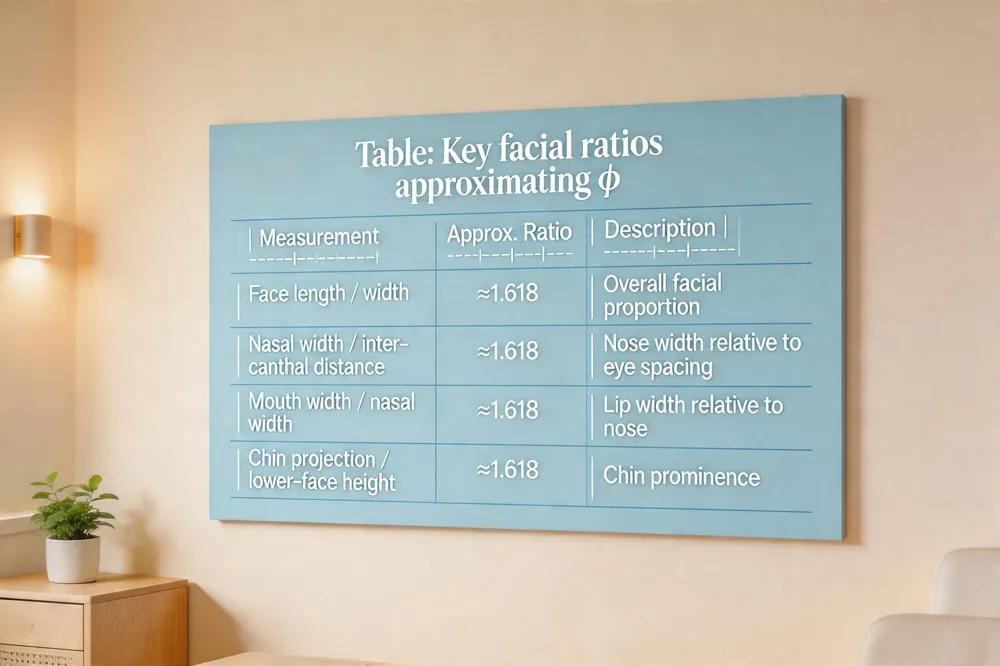 The golden ratio (φ ≈ 1.618) is a mathematical proportion first described by Euclid and seen in shells, spirals, and classical art. In facial plastic surgery it serves as a visual guideline for harmonious proportions—especially the ratio of total facial height to width, the distance from the hairline to the chin versus the eye‑to‑nose distance, and nasal width relative to the inner canthi.
Scientific rationale: the human visual system prefers balanced relationships that maximize symmetry while preserving subtle variation. Studies of facial attractiveness consistently show that ratios near 1.618 (e.g., eye‑mouth to mandible height, nasal height‑to‑width) receive higher aesthetic ratings across ages and cultures.
Key facial measurements approximating φ include: face length ≈ 1.618 × face width; nasal width ≈ 1.618 × inter‑canthal distance; mouth width ≈ 1.618 × nasal width; chin projection ≈ 1.618 × lower‑face height.
Limitations: recent 3‑D stereophotogrammetry research found that only three of ten calculated ratios (R7, R9, R10) matched φ, with no significant sex or attractiveness differences. This suggests the golden ratio is a useful reference, not a universal rule.
What is the golden ratio for face plastic surgery? The Golden Ratio, denoted φ, is approximately 1.618 : 1 and guides surgeons in evaluating facial balance for procedures such as rhinoplasty, chin augmentation, or facelift.
Why is 1.618 beautiful? Because it links a whole to its parts in a way that maximizes symmetry while preserving natural variation, our brain interprets φ‑based proportions as orderly and appealing.
Golden ratio of beauty female In women, a face about 1.618 times longer than it is wide, a lower lip ~1.6 × the upper lip, and lip‑to‑chin distances near φ are considered harmonious.
What is the golden ratio in facial aesthetics? It is a constant of ~1.618 : 1 used to assess proportions such as facial length‑to‑width and nose‑to‑lip distances.
Golden ratio face measurements Typical benchmarks: facial length‑to‑width ≈ 1.6 : 1, inter‑ocular width ≈ 0.46 × face width, nasal width ≈ 0.618 × mouth width, and chin projection ≈ 1.618 × lower‑face height.
Surgical Strategies Guided by the Golden Ratio
Table: Typical procedure ratios and cost ranges
| Procedure | Ideal Ratio | Cost Range (USD) |
|---|---|---|
| Rhinoplasty (total facial height / eye‑to‑mouth) | ≈1.618 | $5,000‑$15,000 (avg $7,600) |
| Chin augmentation (chin height / lower‑face height) | ≈1.618 | $45,000‑$80,000 (combined) |
| Deep‑plane facelift (overall harmony) | ≈1.618 | Included in combined range |
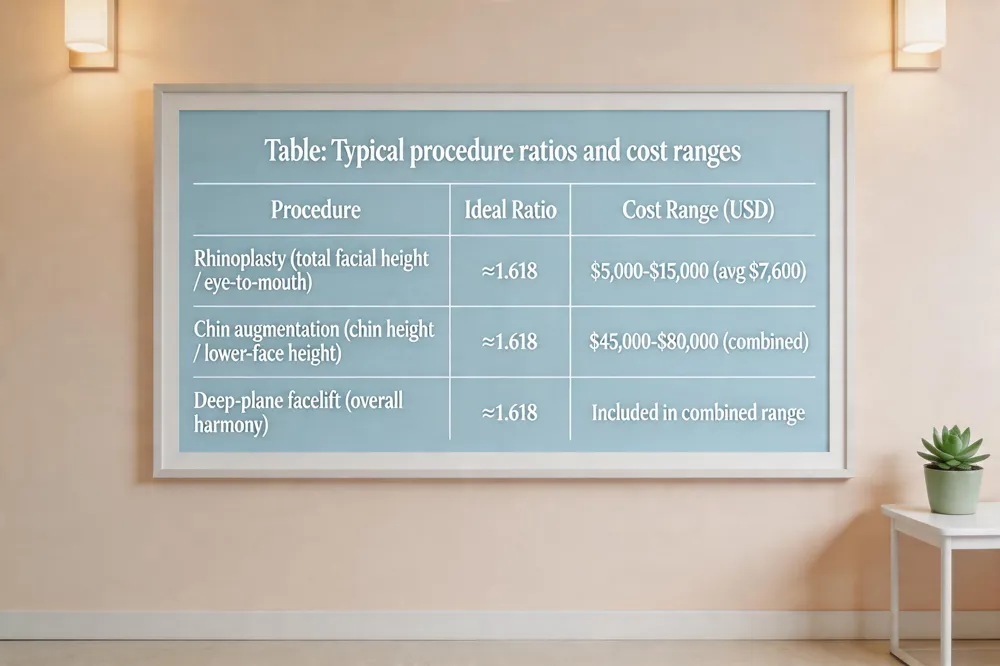 Rhinoplasty is planned by first mapping key facial landmarks with three‑dimensional imaging and then applying golden‑ratio guidelines: the distance from the hairline to the chin should be about 1.618 times the eye‑to‑mouth distance, and the nasal width is often matched to the inter‑canthal width. Surgeons adjust dorsal height, tip projection and alar width until the ratios approach 1.618, while respecting each patient’s ethnicity and gender. For women, an ideal nose is roughly one‑third of total facial height, with a gentle up‑turned tip; for men, a straighter bridge, modest tip projection and proportionate nostrils preserve a masculine profile. The Greek nose—characterized by a high, straight dorsal line and a slightly elevated tip—embodies classical symmetry, whereas a “button” or button‑shaped nose offers a softer, youthful contour. Chin augmentation, using implants or fillers, completes facial harmony by ensuring the chin height aligns with the lower third of the face at a 1.618 proportion to the upper lip. Combined golden‑ratio facial surgery, including deep‑plane facelifts, chin implants and facial fat‑grafting, typically costs $45,000‑$80,000, while standalone rhinoplasty ranges $5,000‑$15,000 (average $7,600), exclusive of anesthesia and facility fees. These figures guide patients in budgeting for a balanced, natural result.
Digital Analysis Tools and Calculators
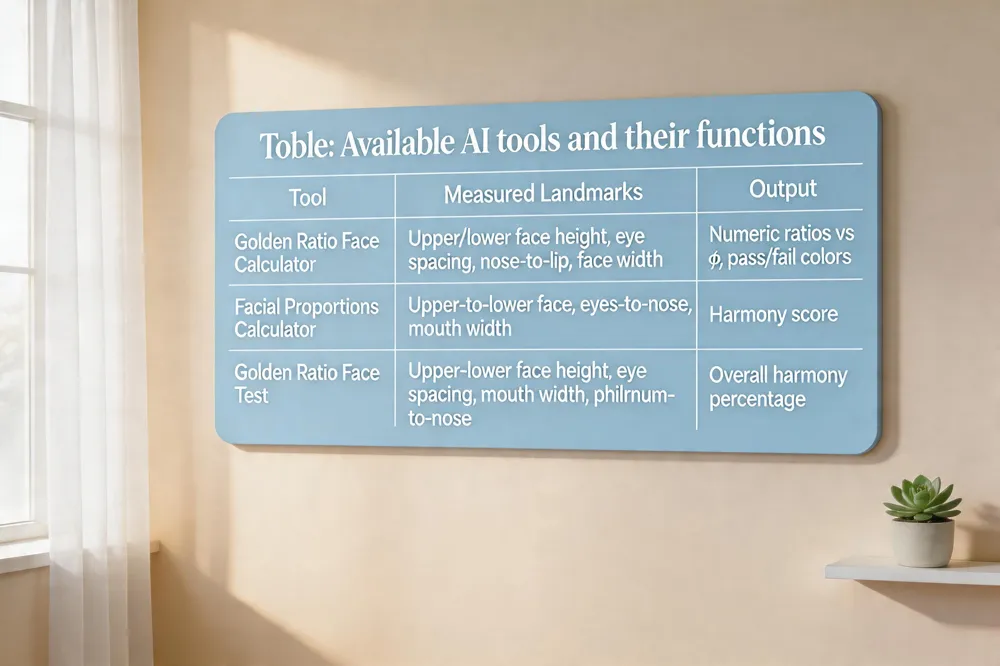
Table: Available AI tools and their functions
| Tool | Measured Landmarks | Output |
|---|---|---|
| Golden Ratio Face Calculator | Upper/lower face height, eye spacing, nose‑to‑lip, face width | Numeric ratios vs φ, pass/fail colors |
| Facial Proportions Calculator | Upper‑to‑lower face, eyes‑to‑nose, mouth width | Harmony score |
| Golden Ratio Face Test | Upper‑lower face height, eye spacing, mouth width, philtrum‑to‑nose | Overall harmony percentage |
 Golden ratio face calculator
A golden‑ratio face calculator is an AI‑driven tool that measures key facial landmarks—upper/lower face height, eye spacing, nose‑to‑lip length, face width—and compares each ratio to φ ≈ 1.618.
Golden ratio face calculator
A golden‑ratio face calculator is an AI‑driven tool that measures key facial landmarks—upper/lower face height, eye spacing, nose‑to‑lip length, face width—and compares each ratio to φ ≈ 1.618.
Golden ratio face calculator upload photo To use it, upload a clear, front‑facing photo (good lighting, no hats, glasses, heavy filters). The AI detects landmarks, calculates ratios, and displays numeric values with color‑coded pass/fail indicators.
Facial proportions calculator Similar to the face‑ratio tool, a facial proportions calculator quantifies distances such as upper‑to‑lower face, eyes‑to‑nose, and mouth width, evaluating how closely they match ideal mathematical relationships.
The golden ratio face test The test measures upper‑lower face height, eye spacing, mouth width, and philtrum‑to‑nose length against φ, providing a harmony score.
Golden ratio face This term refers to a set of proportions—most famously a length‑to‑width ratio of ~1.618—associated with visual harmony.
Limitations and privacy AI analyses are approximations; ethnic, age, and individual variation mean results are guides, not prescriptions. Photo uploads should be encrypted, stored temporarily, and deleted after analysis to protect patient privacy.
Gender‑Specific Ideal Proportions and Celebrity Benchmarks
Table: Gender‑specific benchmarks and celebrity scores
| Gender | Key Ratio | Typical Value | Notable Celebrities (score >93%) |
|---|---|---|---|
| Male | Lower third / total height | ~1.618 | — |
| Female | Face length / width | ~1.618 | Beyoncé, Bella Hadid, Aishwarya Rai, Scarlett Johansson |
 Surgeons often start with gender‑specific golden‑ratio templates. Male faces tend to have a longer lower third and a broader jaw; the vertical eye‑to‑mouth distance is about 36 % of total facial height and inter‑ocular width roughly 46 % of facial width. Female faces are usually evaluated with the classic rule of thirds (hairline‑brows, brows‑nose tip, nose tip‑chin) and five horizontal fifths, aiming for a 1.618 face‑length‑to‑width ratio. The Marquardt Beauty Mask and 3‑D stereophotogrammetry confirm these patterns, but studies show many attractive faces deviate from strict φ values. Celebrities such as Beyoncé, Bella Hadid, Aishwarya Rai, and Scarlett Johansson score >93 % on golden‑ratio analyses, illustrating near‑ideal proportions. However, surgeons personalize plans: digital imaging, ethnic background, and patient goals guide adjustments, ensuring the final result respects individual anatomy while borrowing from these benchmark ratios.
Patient Experience, Costs, and Ethical Perspectives
Table: Cost overview and ethical considerations
| Item | Cost (USD) | Note |
|---|---|---|
| Dermal filler (hyaluronic) | $600‑$1,500 per syringe (avg $715) | Symmetry enhancement |
| Dermal filler (non‑hyaluronic) | $600‑$1,500 per syringe (avg $901) | |
| Financing options | Bundles, interest‑free installments | Improves accessibility |
| Ethical point | Avoid one‑size‑fits‑all φ standard | Respect cultural & individual variation |
 Dermal filler pricing for symmetry typically ranges from $600 to $1,500 per syringe; the national average is about $715 for hyaluronic‑acid products and $901 for non‑hyaluronic options. Before a Golden Ratio‑guided plastic surgery, patients often display imbalanced or asymmetrical contours; after the transformation, facial features align more closely with the timeless 1.618 relationship, yielding a smoother, harmonious silhouette. Ethical considerations arise when a single mathematical standard is applied without regard for cultural, ethnic, and individual variations; surgeons must balance objective ratios with personalized aesthetics to avoid a cookie‑cutter outcome. During a personalized consultation, surgeons review facial analysis, discuss realistic goals, and offer financing plans such as payment bundles or interest‑free installments. A button nose—small, rounded, with a subtle upward tip—can be achieved through minimally invasive rhinoplasty or non‑surgical contouring, further illustrating the blend of art, science, and patient‑centered care.
Conclusion – A Balanced, Personalized Path to Facial Harmony
The golden ratio remains a valuable reference point, not a rigid rule, for achieving facial harmony. Surgeons use it to gauge proportion of the hairline‑to‑chin length, nose width, chin projection and other key distances, but they always adapt the numbers to each patient’s unique anatomy, ethnicity and aesthetic goals. Modern minimally invasive tools—dermal fillers, thread lifts, Botox and three‑dimensional imaging—allow fine‑tuning of these relationships without extensive surgery, preserving natural character while moving ratios closer to the ideal balance. At the Aesthetic Surgery Center in San Francisco, our board‑certified team blends scientific analysis with artistic judgment. We invite you to schedule a personalized consultation to explore how a tailored, proportion‑based plan can enhance your natural beauty. Our approach also considers skin quality, volume loss, and health to ensure results.