Why Asking the Right Questions Matters
During the initial consultation, asking the right questions protects your health, clarifies the surgeon’s qualifications, and helps you visualize achievable results. Patient safety begins with informed consent; a board‑certified surgeon should explain the specific risks, anesthesia plan, and emergency protocols, and confirm that the procedure will be performed in an accredited hospital or office‑based facility. Verifying credentials—American Board of Plastic Surgery certification, ASPS membership, and hospital privileges—ensures the doctor has completed rigorous training and maintains high ethical standards. Reviewing the surgeon’s case volume and before‑and‑after photos of patients with similar anatomy sets realistic expectations and reduces the chance of disappointment. Ultimately, transparent dialogue empowers you to make a confident, well‑informed decision. It also guides you through postoperative care and follow‑up plans.
Understanding Your Plastic Surgery Consultant
| Aspect | Details |
|---|---|
| Primary Role | First point of contact; guides from goal assessment through post‑procedure follow‑up |
| Evaluation | Facial & body assessment, medical history review, risk/benefit discussion |
| Board Certification | 6‑year residency + American Board of Plastic Surgery exams; ASPS member |
| Personalized Planning | Tailors recommendations to anatomy, lifestyle, budget; shows before‑and‑after photos |
| Procedures Discussed | Surgical & minimally invasive options (laser resurfacing, fillers, body‑contouring) |
| Outcome Focus | Safety, comfort, natural‑looking results, ongoing education on latest techniques |
 A plastic surgery consultant serves as the first point of contact in aesthetic care, guiding you from initial goals assessment through post‑procedure follow‑up. The consultant conducts a thorough facial and body evaluation, reviews your medical history, and explains the risks, benefits, and realistic outcomes of each option.
Board certification and training are the cornerstones of safety and expertise. A board‑certified plastic surgeon has completed a 6‑year residency, passed the rigorous exams of the American Board of Plastic Surgery, and maintains membership in the American Society of Plastic Surgeons, which requires ongoing education and adherence to high ethical standards. This credentialing ensures the surgeon possesses the technical skill and knowledge to perform complex procedures in accredited facilities.
Personalized treatment planning tailors every recommendation to your anatomy, lifestyle, and desired results. The consultant will discuss surgical versus minimally invasive alternatives, show before‑and‑after photos of patients with similar anatomy, and outline a detailed recovery timeline and post‑operative care plan.
Plastic surgery consultant A plastic surgery consultant is a board‑certified specialist who evaluates your aesthetic goals, reviews your medical history, and recommends personalized treatment options that align with your desired outcomes. At our San Francisco Aesthetic Surgery Center, the consultant conducts a thorough facial and body assessment, explains the risks and benefits of both surgical and minimally invasive procedures, and creates a tailored plan that fits your lifestyle and budget. They guide you through the entire process—from initial consultation and pre‑operative preparation to post‑procedure care—ensuring safety, comfort, and natural‑looking results. Our consultants stay current with the latest techniques and technologies, allowing you to benefit from cutting‑edge treatments such as laser resurfacing, injectable fillers, and advanced body‑contouring methods. Schedule a private consultation today to discover how a dedicated plastic surgery consultant can help you achieve your most confident self.
Plastic surgery questions and answers Plastic surgery encompasses both reconstructive procedures that restore function after injury, disease, or birth defects, and aesthetic (cosmetic) surgeries that improve appearance and self‑esteem. A qualified plastic surgeon must complete a general surgery residency followed by a dedicated plastic‑surgery fellowship and hold voluntary board certification from the American Board of Plastic Surgery. Common aesthetic procedures include rhinoplasty, facelifts, eyelid surgery, chin and ear reshaping, breast augmentation, and body‑contouring lifts, all of which are performed with personalized, minimally invasive techniques whenever possible. While most surgeries leave small, well‑placed incisions that heal into faint scars, certain methods—such as laser resurfacing or scar‑revision surgery—can further minimize their visibility. Prior to any operation, a thorough consultation will assess your goals, medical history, and realistic outcomes, ensuring safety and optimal results.
Preparing for Your Consultation: Logistics and Comfort
| Item | Recommendation |
|---|---|
| Clothing | Loose‑fitting, layered (t‑shirt, hoodie, jeans/slacks); avoid rear‑zip dresses or tight buttons |
| Additional Items | Warm socks or light sweater; extra tops/bras/bikini‑style top for breast work |
| Consultation Fee | $100‑$250 (often applied toward procedure cost or waived with financing) |
| Dermatology vs. Plastic Surgery | Dermatology = skin, hair, nail health, topical/laser treatments; Plastic surgery = surgical candidacy, anesthesia, facility, recovery |
| Comfort Tips | Bring water, list questions, arrive early to settle in before examination |
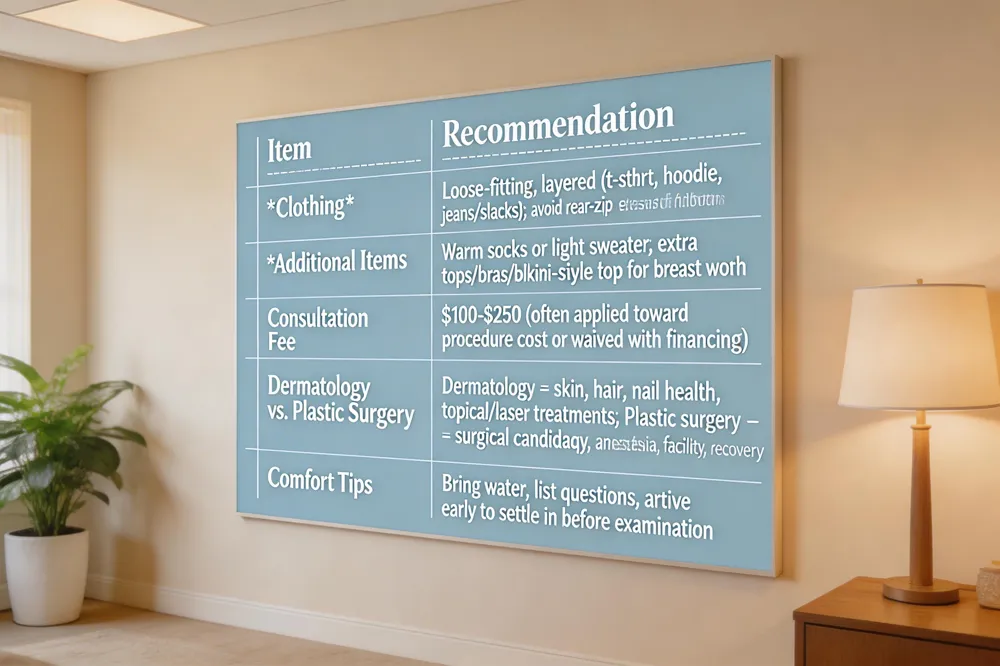 When you step into a plastic‑surgery office, the first practical step is what you wear and bring. Choose loose‑fitting, layered clothing—soft a‑shirt, hoodie, jeans or slacks—so you can easily uncover the area under discussion. Avoid tricky closures like rear‑zip dresses or tight buttons, and bring warm socks or a light sweater because exam rooms can feel chilly once shoes are removed. If you are considering breast work, pack a few extra tops, bras, or a bikini‑style top to help the surgeon illustrate how different implant sizes will look.
Consultation fees vary by practice but typically range from $100 to $250. Many surgeons apply the fee toward the total cost of any procedure you ultimately choose, and some centers waive the charge when you enroll in a financing or membership program. The fee covers a thorough assessment, goal discussion, and a personalized treatment plan.
A cosmetic consultation with a dermatologist differs from a plastic‑surgery visit. Dermatologists focus on skin, hair, and nail health, reviewing your medical history and current regimen, then recommending topical, laser, or minimally invasive treatments. Plastic surgeons, in contrast, evaluate surgical candidacy, discuss operative techniques, and outline anesthesia, facility, and recovery details. Both appointments are educational, but the surgeon’s consultation centers on procedural safety, hospital privileges, and post‑operative care, while the dermatologist’s session emphasizes skin‑specific therapies and non‑surgical options.
Key Questions for Specific Procedures
| Procedure | Core Questions |
|---|---|
| Facelift | Board certification, annual case volume, technique (SMAS, deep‑plane), hospital privileges, before‑and‑after photos, recovery timeline, pain‑management, complication protocol |
| Tummy Tuck | Board certification, abdominoplasty training, technique (traditional/mini/extended), scar placement, drains, scar‑minimization, recovery schedule, seroma/infection management |
| Breast Reduction | Certification, yearly volume, surgical approach, facility type, anesthesia plan, insurance documentation, recovery limits, postoperative care |
| Facelift for 70‑year‑old | Health status, skin quality, facial laxity, technique suitability, risk discussion, adjunctive treatments |
| Blepharoplasty Regret Rate | 5‑10 % dissatisfaction within first year (per Aesthetic Surgery Journal) |
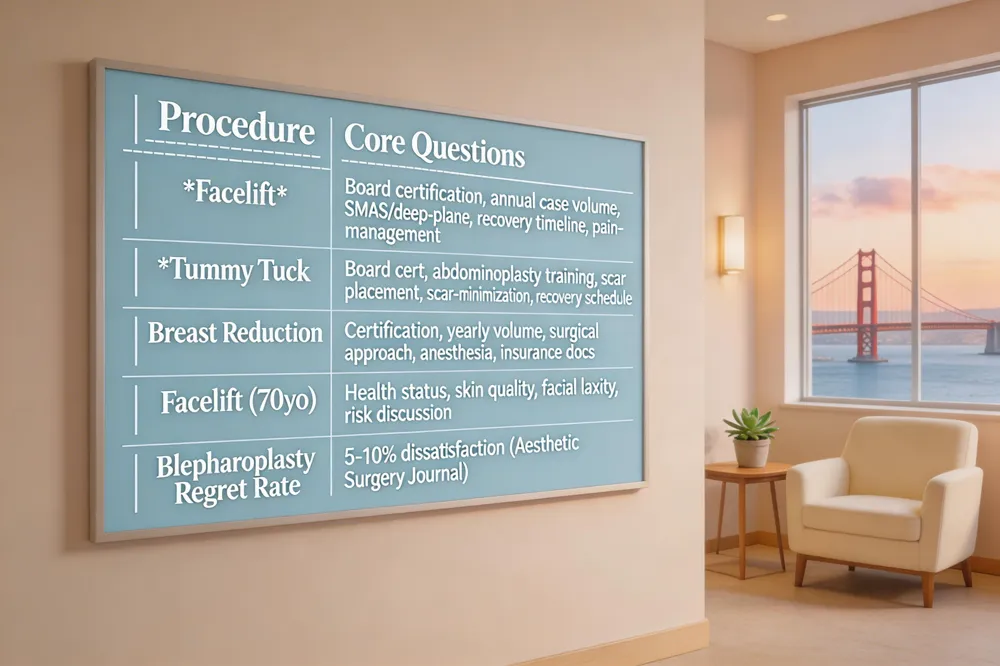 When preparing for a cosmetic consultation, asking the right questions helps ensure safety, realistic expectations, and optimal outcomes.
Questions to ask a plastic surgeon before a facelift – Verify board certification by the American Board of Plastic Surgery and years of dedicated facial‑rejuvenation training. Ask how many facelifts are performed annually, which techniques (SMAS, deep‑plane, etc.) are recommended for your anatomy, and whether the surgeon has hospital privileges and an accredited facility. Request before‑and‑after photos of patients with similar concerns, discuss the recovery timeline, pain‑management plan, and postoperative support. Finally, inquire about potential risks, the surgeon’s protocol for complications, and revision options.
Questions to ask a plastic surgeon about a tummy tuck – Confirm board certification and specific abdominoplasty training. Ask which technique (traditional, mini, extended) suits your body type, expected scar placement, use of drains, and scar‑minimization strategies. Discuss the recovery schedule, activity restrictions, and how seroma or infection would be managed. Review before‑and‑after photos of comparable patients.
Pre‑operative questions for breast reduction – Verify board certification and annual case volume. Ask about the surgical approach, facility (hospital vs. outpatient), anesthesia plan, and insurance documentation requirements. Clarify recovery timelines, activity limits, and postoperative care. Request photo examples and discuss complication management.
Is a facelift appropriate for a 70‑year‑old? – Age alone isn’t a contraindication; health status, skin quality, and facial laxity are key. Modern deep‑plane or minimally invasive techniques can safely rejuvenate older patients when chronic illnesses are controlled. A thorough consultation should address realistic expectations, risks, and adjunctive treatments.
Regret rate for blepharoplasty – Recent Aesthetic Surgery Journal data show a 5‑10 % dissatisfaction rate within the first year after eyelid surgery.
Pre‑Operative Planning and Checklists
| Timeline | Action Items |
|---|---|
| 2‑4 weeks before | Nutrient‑rich diet, stay hydrated, stop alcohol, smoking, NSAIDs (aspirin, ibuprofen, Vitamin E) |
| 1 week before | Obtain medical clearance, complete labs/EKG/urinalysis, send results to surgeon |
| 2 weeks before | Cease all nicotine products |
| 1 week before | No alcohol; confirm test results |
| Night before | Light clear‑liquid dinner, fast after midnight (no food, water, gum, meds except small water sip with pills) |
| Day of surgery | Bring post‑op comfort kit: loose front‑button clothing, abdominal binder, ice packs, stool softeners, entertainment |
| Pain Expectation | 6‑7/10 first few days, dropping to 3‑4/10 by end of week two |
| Post‑op Care | Compression garment, prescribed pain meds, follow‑up visits |
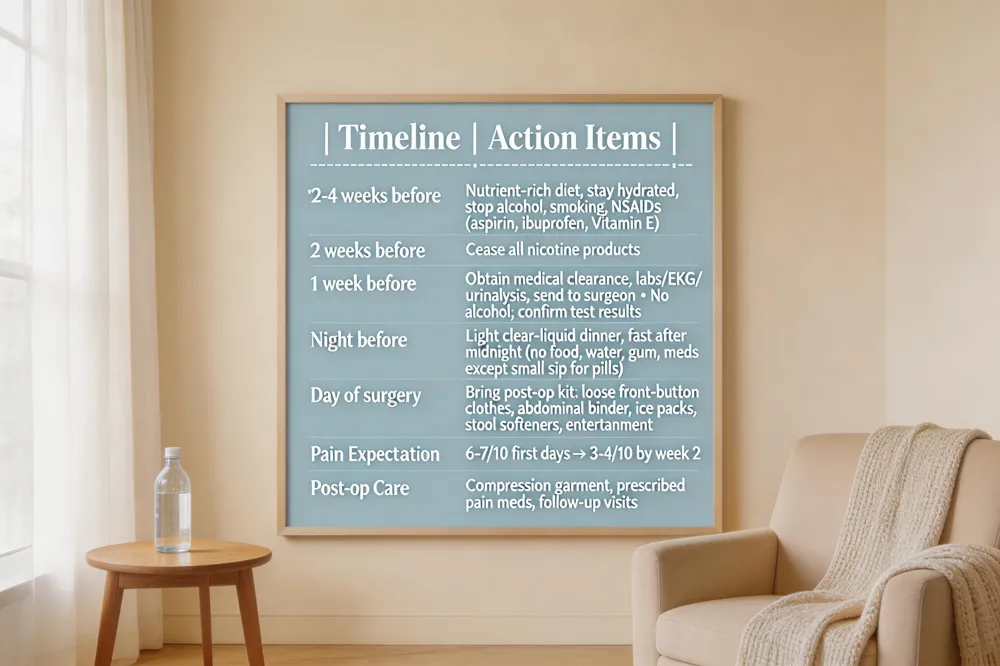 Preparing for a tummy tuck begins 2–4 weeks before surgery. Eat a nutrient‑rich, low‑processed‑food diet, stay well‑hydrated, and eliminate alcohol, smoking, and non‑steroidal anti‑inflammatory drugs (including aspirin, ibuprofen, and Vitamin E). Schedule a pre‑op visit with a board‑certified plastic surgeon to obtain medical clearance, review your health history, and complete any required labs, EKG, or urinalysis at least one week before the procedure. Two weeks prior, stop all nicotine products; one week before, refrain from alcohol and confirm that all test results have been sent to the surgical office. The night before surgery, have a light, clear‑liquid dinner and fast after midnight (no food, water, gum, or medication except a small sip of water with prescribed pills). Assemble a post‑op comfort kit—including loose front‑button clothing, a supportive abdominal binder, ice packs, stool softeners, and entertainment—to ensure a smooth recovery.
Patients typically rate postoperative pain a tuck‑a a 6–7 out of 10 during the first few days, dropping to a 3–4 by the end of the second week. Pain varies with individual tolerance and whether liposuction is combined with the lift; surgeons prescribe pain‑relief medication and a compression garment to keep discomfort manageable.
During the initial plastic surgery consultation you will meet the surgeon privately, discuss aesthetic goals, medical history, and current medications. The surgeon will perform a physical exam, review before‑and‑after photos of similar patients, and explain procedure options, benefits, risks, and recovery timeline. You will receive a personalized treatment plan, have the opportunity to ask about board certification, anesthesia, facility accreditation, and financing, and leave the visit feeling informed and confident about the next steps.
Safety, Credentials, and Facility Standards
| Verification Item | Details |
|---|---|
| Board Certification | American Board of Plastic Surgery (ABPS) certification |
| Professional Membership | American Society of Plastic Surgeons (ASPS) membership ensures ongoing education & ethics |
| Hospital Privileges | Surgeon must disclose privileges; confirm surgery location in accredited facility |
| Facility Accreditation | Hospital, AAAHC or JCAHO‑accredited ambulatory surgery center, or state‑licensed Medicare‑certified office suite |
| Emergency Protocols | Clear plan for managing complications, access to emergency care, revision policy outlined |
| Five Pillars of Surgery | Trauma, surgical critical care, emergency general surgery, elective general surgery, surgical rescue |
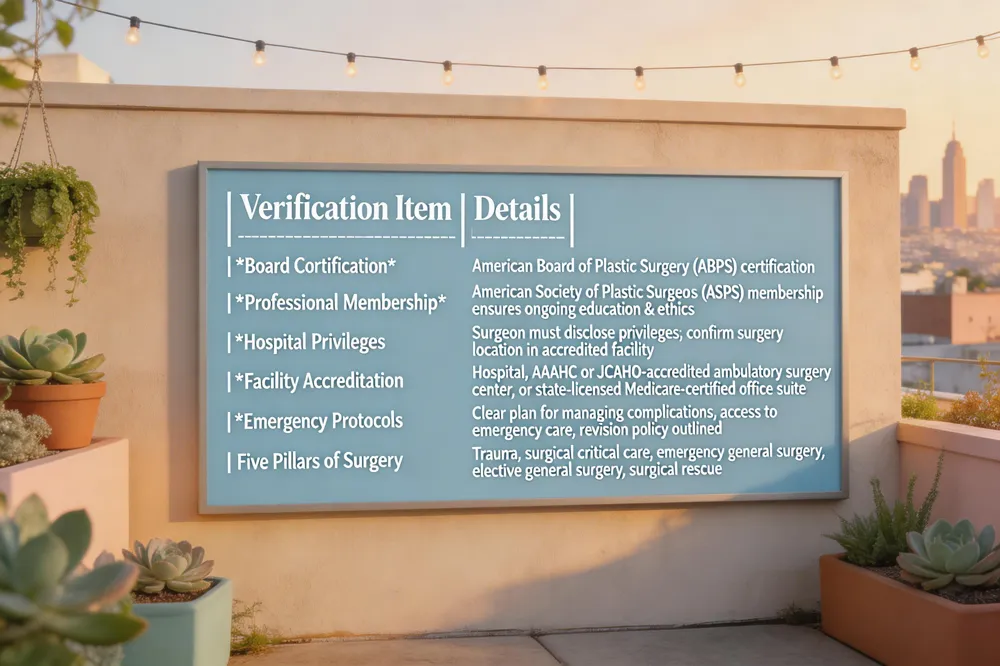 When choosing a plastic surgeon, verify that they are Board certification by the American Board of Plastic Surgery and a member of the American Society of Plastic Surgeons (ASPS), which ensures ongoing education and ethical standards. Ask the surgeon to disclose their hospital privileges and confirm that the surgery will be performed in an accredited facility—whether a hospital, an ambulatory surgery center accredited by AAAHC or JCAHO, or a state‑licensed, Medicare‑certified office‑based suite. Understanding the practice’s emergency protocols and revision policies is critical; a reputable surgeon will outline how complications are managed, the availability of emergency care, and the process for revision surgery if outcomes are unsatisfactory.
What are the five pillars of surgery?
Acute care surgery (ACS) encompasses five major pillars – trauma, surgical critical care, emergency general surgery, elective general surgery, and surgical rescue.
Take the Next Step with Confidence
Before you commit to a procedure, review a personalized consultation checklist that includes verifying board certification by the American Board of Plastic Surgery, confirming the surgeon’s ASPS membership, and ensuring the surgical facility is accredited (AAAHC, JCAHO, or state‑licensed). Compare at least two qualified surgeons by asking how many times they have performed your specific operation, reviewing before‑and‑after photos of patients with similar anatomy, and checking hospital privileges and anesthesia credentials. During your private consultation, bring a full medical history, a list of questions, and a trusted companion to help note details. A clear, written plan covering the surgical technique, recovery timeline, risks, and cost breakdown will give you confidence and peace of mind as you move forward.