Introduction
Double eyelid surgery, also called Asian blepharoplasty, creates a permanent upper‑eyelid crease that enlarges the visible eye and adds symmetry. For many individuals of Asian descent, the procedure carries cultural and aesthetic significance, allowing patients to achieve a look that feels both modern and true to their heritage. Today’s surgeons prioritize personalized, minimally invasive care—combining precise crease‑height planning with techniques ranging from ultra‑thin suture‑only methods to full‑incision approaches—so each patient’s unique anatomy and aesthetic goals are respected while minimizing downtime and scarring. This guide walks you through the anatomy, candidacy criteria, surgical options, recovery timelines, and postoperative care, giving you a clear picture of what to expect before, during, and after your journey to a natural‑looking double eyelid.
Fundamentals of Blepharoplasty
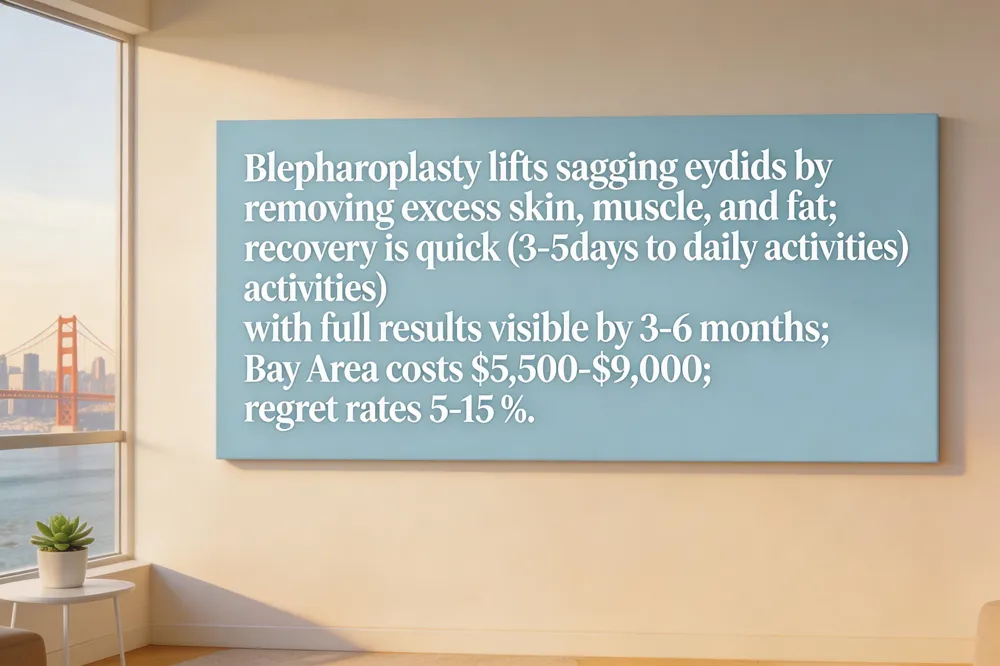 Blepharoplasty, often called an eyelid lift, is the most frequently performed eyelid surgery worldwide. Whether addressing upper, lower, or both lids, the procedure removes excess skin, muscle, and fat to improve sagging, puffiness, and, in some cases, peripheral vision. Small incisions placed in the natural crease hide scarring, making the operation a top choice for both aesthetic rejuvenation and functional correction.
Typical recovery timeline – Most patients feel comfortable resuming everyday activities within 3‑5 days, and makeup can be reapplied after 7‑10 days once bruising subsides. Swelling and bruising continue to diminish over the first two weeks, with full return to normal routines around that time. Light lifting and vigorous exercise should be avoided for at least two weeks. The final aesthetic result becomes clear between 3 and 6 months, and can continue to refine for up to a year.
Upper eyelid surgery cost in the Bay Area – In San Francisco aesthetic centers, upper blepharoplasty generally ranges from $5,500 to $9,000, covering surgeon fees, facilities, and anesthesia. National averages sit near $3,300 for the surgeon’s fee alone, but the high cost of living and premium surgical suites push Bay‑Area prices higher. Financing options are common, and while cosmetic cases are usually not covered by insurance, functional procedures may qualify for partial reimbursement.
Regret rates and patient satisfaction – Studies report a regret or dissatisfaction rate of roughly 5 % to 15 %. Lower rates correspond with realistic expectations and experienced, board‑certified surgeons; higher rates often involve unmet aesthetic goals. Most regret stems from cosmetic concerns rather than medical complications.
Prevalence of natural double eyelids – Natural double eyelids are not rare; about half of East Asian individuals possess a visible supratarsal crease, a normal anatomical variation driven by levator aponeurosis attachment. Thus, a natural double eyelid is common, not an uncommon trait.
Asian Blepharoplasty Techniques
 Asian blepharoplasty—commonly called double‑eyelid surgery—offers several ways to create a natural‑looking crease while preserving ethnic features.
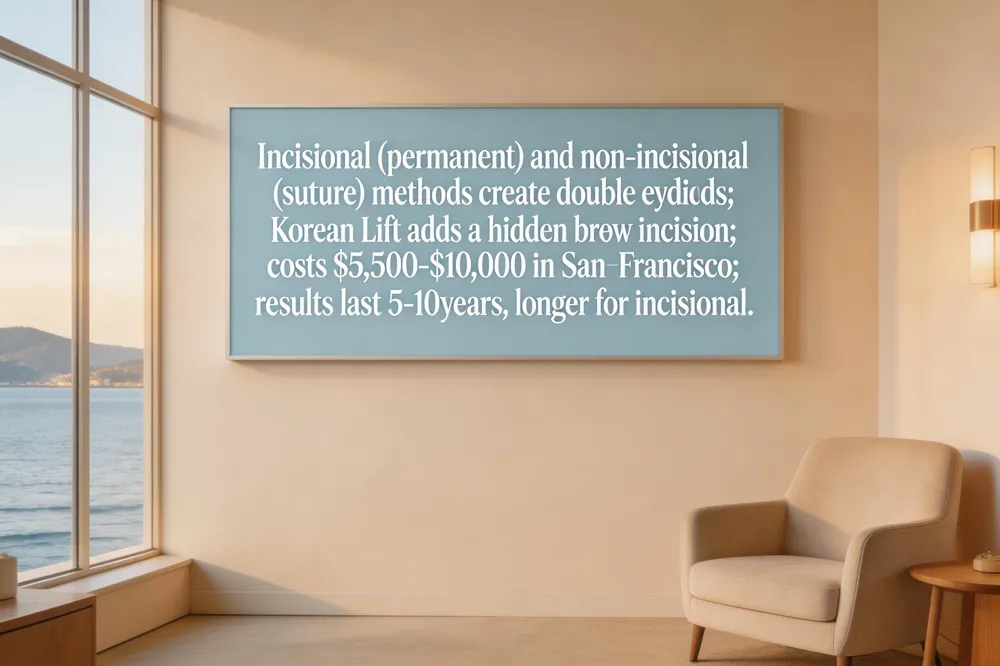
Incisional vs non‑incisional methods – Incisional (open) blepharoplasty removes excess skin, muscle, or fat and secures the levator aponeurosis to the skin, delivering a permanent, durable crease. This technique is ideal for patients with thick skin, significant hooding, or excess fat. Non‑incisional (suture‑only) approaches use tiny punctures or a few fine stitches to anchor the skin to the underlying muscle, avoiding any external scar. It is faster, involves less swelling, and is best for thin‑skinned lids without excess tissue.
Korean blepharoplasty and the Korean Lift – The Korean style emphasizes a subtle, almond‑shaped eye with a crease height of 3‑6 mm for North‑Eastern Asian descent and 7‑10 mm for South‑Eastern Asian descent. The “Korean Lift” (infrabrow incision) removes a small strip of skin just beneath the brow, hidden the scar under hair and giving a lifted appearance while maintaining a natural crease.
Durability of results – Asian blepharoplasty generally provides long‑lasting results, often stable for 5 – 10 years or more. Incisional techniques tend to hold up longer than non‑incisional sutures, which may loosen over time. Aging, skin elasticity, and sun exposure can gradually soften the crease, but proper postoperative care and a healthy lifestyle help preserve the outcome.
Cost ranges for different techniques – In the San Francisco Bay Area, a full incisional procedure typically costs $7,000‑$10,000, reflecting surgeon fees, facility charges, and anesthesia. Non‑incisional (suture) surgery is less invasive and usually priced between $5,500‑$8,500. Adding epicanthoplasty or ptosis correction can increase the total cost by several thousand dollars. Across the United States, overall prices range from $5,000 to $12,000, depending on technique, surgeon experience, and geographic location.
Combining epicanthoplasty and ptosis correction – Many surgeons, such as Dr. Taban in Los Angeles, address epicanthal folds and eyelid ptosis in the same session. Epicanthoplasty reduces the medial skin flap, widening the eye, while ptosis repair lifts a drooping lid, enhancing symmetry and visual field. These combined procedures are performed under local anesthesia with optional sedation, allowing same‑day discharge and a recovery timeline of 7‑10 days.
Overall, the choice between incisional and non‑incisional blepharoplasty, the inclusion of a Korean Lift, and any adjunctive epicanthoplasty or ptosis correction should be personalized to each patient’s anatomy, aesthetic goals, and lifestyle. A thorough consultation with a board‑certified oculplastic surgeon will determine the optimal plan and provide a detailed, itemized cost estimate.
Non‑Surgical Alternatives and Complementary Procedures
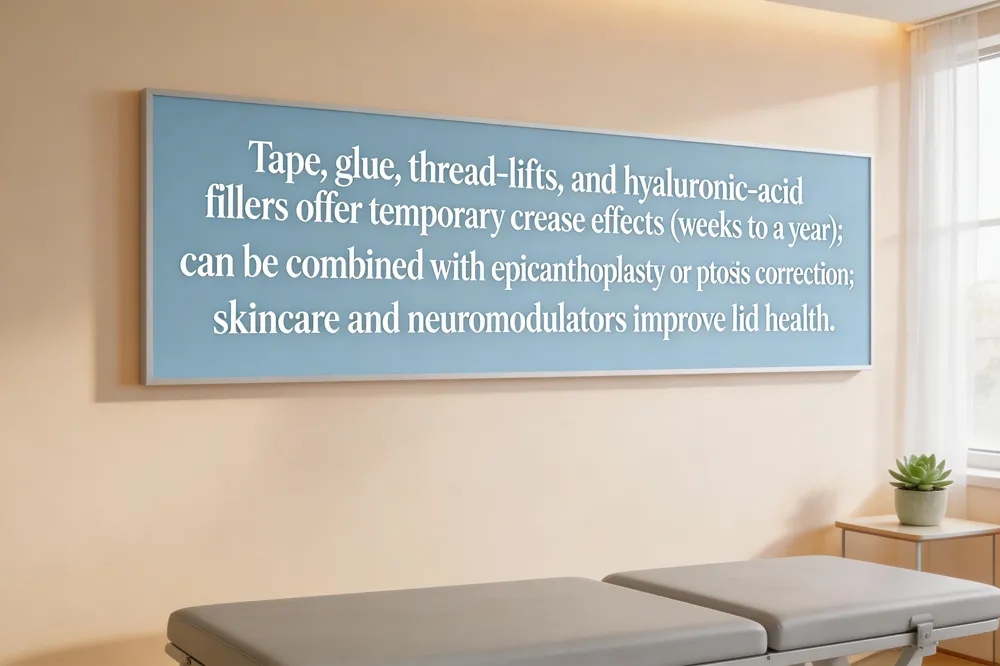 For patients who are not ready for permanent blepharoplasty, a range of non‑surgical options can create a temporary double‑eyelid effect. The simplest method is adhesive tape or medical‑grade eyelid glue, which are applied to clean skin each morning to produce an instant fold. Thread‑lift sutures and hyaluronic‑acid dermal fillers are semi‑permanent alternatives; a fine absorbable thread placed under the skin or a small volume of filler in the pretarsal area can maintain a crease for 6–12 months.
When the inner corner of the eye is prominent, a minimally invasive epicanthoplasty can be combined with suture‑only double‑eyelid creation to widen the eye and improve symmetry. Ptosis correction—often a subtle levator lift—may also be performed in the same session to raise a low‑lying lid and prevent eyelashes from brushing the cornea.
Results from tape, glue, or thread‑lift are immediate but dissolve within weeks to months, whereas fillers and sutured techniques can last up to a year before the tissue remodels. Supporting skin health with a targeted skincare regimen—hydrating moisturizers, retinoids, antioxidants—alongside neuromodulator treatments (e.g., Botox®) can enhance lid elasticity and reduce puffiness, further refining the non‑surgical appearance. These complementary strategies allow patients in San Francisco to experiment with crease height and shape before committing to a permanent surgical solution.
Patient Qualification, Safety, and Expectations
 To qualify for Asian blepharoplasty or any eyelid surgery, patients must be in good overall health, with controlled chronic conditions and no active eye disease. Smoking cessation at least four weeks before and after the procedure is strongly advised because nicotine impairs wound healing and raises infection risk. Realistic expectations are essential; candidates should understand that the goal is a natural‑looking crease that respects their ethnic features, not a Westernized look. Selecting a board‑certified oculplastic or facial plastic surgeon—such as Dr. Taban in Los Angeles, Dr. Cytryn in Bethesda, or surgeons at San Francisco’s Aesthetic Surgery Center—helps ensure expertise, safe anesthesia, and appropriate technique selection (incisional, partial‑incision, or non‑incisional). Potential complications include asymmetry, suture loosening, scarring, dry eye, or temporary eyelash shedding; these are mitigated through meticulous pre‑operative assessment, sterile technique, and postoperative care instructions. Post‑operative guidelines emphasize rest, head elevation, cold compresses, avoidance of smoking, and a gradual return to activities, with sutures removed 4‑6 days for incisional methods. Functional surgery (e.g., ptosis correction) follows the same health prerequisites but may be covered by insurance when vision is impaired.
Choosing the Right Surgeon in San Francisco
 The Aesthetic Surgery Center in San Francisco embraces a philosophy of “natural‑looking results that respect each patient’s ethnic heritage.” Board‑certified oculplastic specialists such as Dr. Taban and Dr. McDonald bring decades of fellowship training, extensive experience in Asian blepharoplasty, and a commitment to safety and personalized care. During the initial consultation the surgeon conducts a thorough eyelid anatomy evaluation—measuring pretarsal skin thickness, fat distribution, and epicanthal fold type—to recommend an ideal crease height (3‑6 mm for North‑Eastern Asian descent, 7‑10 mm for South‑Eastern Asian descent) and the most suitable technique, whether full‑incision, partial‑incision, or non‑incisional suture. Many patients elect to combine the double‑eyelid creation with epicanthoplasty or ptosis correction in a single session, minimizing overall downtime. post‑operative follow‑up includes scheduled visits for suture removal (if applicable), swelling management, and progression of final results, with a dedicated nurse line for any concerns.
Non‑incisional double eyelid surgery cost: In the San Francisco Bay Area, non‑incisional (suture) double‑eyelid surgery typically costs between $5,500 and $8,500 total, covering the surgeon’s fee, facility charges, and anesthesia. The procedure is quicker and less invasive than the full‑incision method, usually taking about 15 minutes in the operating room. Additional procedures such as epicanthoplasty or ptosis correction can increase the overall price; a detailed, itemized quote is provided at consultation.
How much does a double eyelid (Asian blepharoplasty) cost?: For a full double‑eyelid (Asian blepharoplasty) in San Francisco, patients can expect to pay roughly $7,000 to $10,000. Simpler non‑incision techniques fall at the lower end, while full‑incision methods that remove excess skin, muscle, or fat tend toward the upper end. Epicanthoplasty or ptosis correction add several thousand dollars. Prices vary with surgeon experience, facility location, and anesthesia type; an itemized quote is essential during the initial visit.
Conclusion
Asian blepharoplasty offers a spectrum of solutions—from quick, non‑incisional suture or tape methods that provide temporary, scar‑free creases to full‑incision techniques that remove excess skin and fat for permanent, durable results. Each option is tailored to the patient’s eyelid anatomy, desired crease height (3‑10 mm based on ethnic background), and lifestyle considerations. Selecting a board‑certified oculoplastic or plastic surgeon—such as those at the Aesthetic Surgery Center—ensures expertise in the nuanced anatomy of Asian eyelids, personalized surgical planning, and meticulous post‑operative care. Prospective patients are invited to schedule a consultation to discuss goals, explore the most appropriate technique, and learn how to achieve a natural‑looking double eyelid that respects ethnic features while delivering lasting satisfaction. With skilled, individualized care, the journey to brighter, more harmonious eyes is both safe and rewarding.